
Why Granite Cracks Behind the Sink—and Why These Cracks Shouldn’t Be Ignored
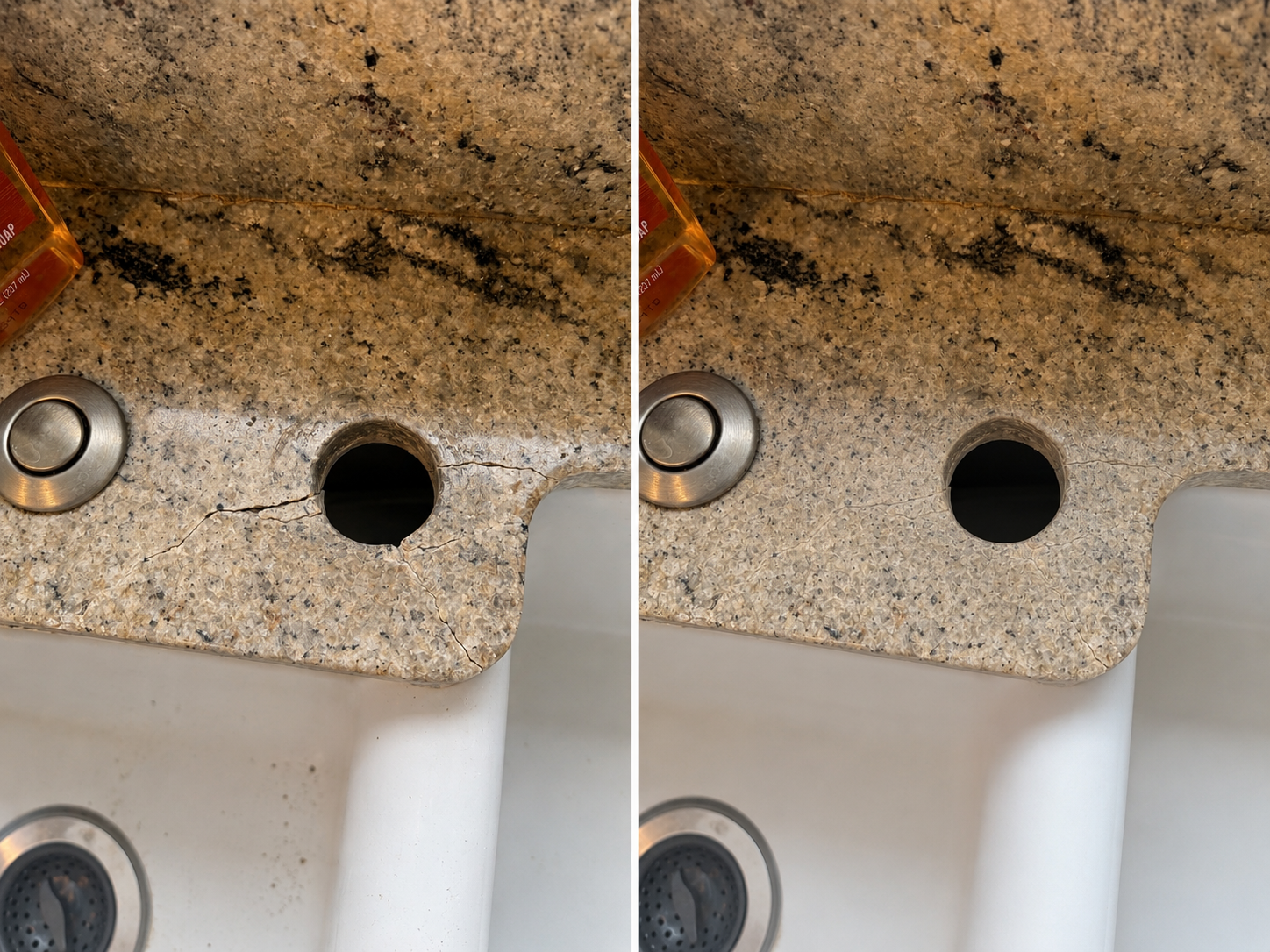
A crack.
And it’s running through the narrow strip of granite directly behind the sink.
At first, it may look insignificant. Maybe it’s only a thin line. Perhaps the two sides are still relatively level. Nothing is loose, and the sink hasn’t moved.
So you decide to keep an eye on it.
Six months later, the crack is wider.
One side may be slightly higher than the other. The area moves when pressure is applied. The sink caulking may be separating. In more severe cases, the narrow section of granite behind the sink begins breaking into multiple pieces.
At Sureshine Care and Restoration Services, Inc., we’ve repaired many granite countertops with exactly this type of failure.
And one of the most important things homeowners should understand is this:
A crack behind the sink may not simply be a cosmetic crack.
It can be evidence that something within or beneath the countertop has failed.
Understanding what caused the failure is the first step toward repairing it correctly.
Why Is the Area Behind a Sink Vulnerable?
A granite slab may be large and substantial, but once openings are cut into it for sinks, cooktops, and faucets, some areas become considerably narrower than others.
The strip of granite running behind a sink is a good example.
Fabricators often refer to narrow sections around a sink opening as sink rails.
Depending on the sink design, countertop depth, faucet placement, and fabrication, the rear sink rail may be only a few inches wide.
That narrow strip still has to deal with forces affecting the rest of the countertop.
Those forces can include:
- Movement in the cabinets
- Movement in the countertop
- Sink loads
- Plumbing vibration
- Thermal expansion and contraction
- Stress around faucet holes
- Inadequate support
- Moisture intrusion
If enough stress develops in a weakened area, the granite can crack.
A Natural Fissure Is Not Necessarily a Structural Crack
Before assuming every line in granite is damage, it’s important to understand the difference between a natural fissure and a structural crack.
Granite is a natural material. Depending on the stone, it can contain veins, mineral boundaries, fissures, and other geological features that formed long before the slab became a countertop.
A natural fissure may be visible but completely stable.
A structural crack is different.
Signs that a crack may represent actual movement or failure include:
- A crack that appeared after installation
- A crack that is becoming wider
- Vertical displacement between the two sides
- Movement when pressure is applied
- Separation near the sink
- Cracking through or near faucet holes
- Multiple connected cracks
- Loose sections of stone
Location also matters.
A new crack running across a narrow sink rail deserves attention because that section of the countertop is already structurally vulnerable.
You can learn more about professional granite crack repair and how Sureshine approaches structural countertop failures.
Water Is Often Part of the Story
Think about what happens around a kitchen sink every day.
Water splashes behind the faucet.
The countertop gets wiped down.
Soap and water collect around the sink rim.
The faucet base gets wet.
And the caulking between the sink and countertop doesn’t remain perfect forever.
If caulking deteriorates, water can begin entering areas where it was never intended to go.
That doesn’t automatically mean the granite itself will be damaged by the water. The concern is what the water can reach beneath or inside the countertop assembly.
Depending on how the countertop was fabricated and installed, that may include:
- Wood supports
- Cabinet components
- Adhesives
- Metal reinforcement
- Sink mounting components
Over years of repeated exposure, moisture can contribute to conditions that eventually result in movement or failure.
The Hidden Problem: Steel Reinforcement Inside Granite
One of the most interesting causes of sink-rail failure may be completely invisible from the surface.
Historically, some granite countertops were reinforced around sink openings by cutting a channel into the underside of the stone and installing a steel rod.
This technique is commonly called rodding.
The concept made sense.
The narrow sections around a sink opening can be vulnerable during fabrication, transportation, and installation. A reinforcing rod could help strengthen those areas.
But ordinary steel has one major weakness.
It rusts.
How a Rusting Rod Can Crack Granite
If moisture reaches embedded steel reinforcement, corrosion can begin.
Rust isn’t simply a discoloration on the metal.
As steel corrodes, the corrosion products occupy more volume than the original steel. That expansion can generate significant pressure within the narrow channel where the rod is embedded.
Now imagine that pressure developing inside a narrow strip of granite.
The expanding corrosion can push against the surrounding stone.
Eventually, the granite may crack.
This is why a homeowner may see a crack along the sink rail even though nobody dropped anything on the countertop.
The force creating the damage may be developing inside the countertop itself.
Why the Rear Sink Rail Can Be Especially Difficult
Cracks along the front of a sink are usually easy to see.
A rear sink-rail crack can be much less obvious.
Several things make this area difficult:
The backsplash may limit access.
A faucet may sit directly in the affected area.
Soap dispensers, air gaps, filtered-water faucets, and other fixtures may occupy the same narrow strip.
The crack may run through one or more drilled holes.
And because the area is behind the sink, homeowners may not notice movement until the failure has progressed significantly.
By the time we’re called, there may be more happening than the thin surface crack initially suggests.
Why Simply Filling the Crack May Not Solve the Problem
This is one of the biggest distinctions between cosmetic crack filling and structural granite repair.
Imagine that a rusting steel rod is expanding underneath the countertop.
If someone simply places adhesive into the visible crack and smooths the surface, what happened to the rod?
Nothing.
The source of the pressure is still there.
The repair may look better temporarily, but the underlying condition has not necessarily been corrected.
The same principle applies if the countertop is moving because of inadequate support.
Filling the visible crack without addressing movement doesn’t eliminate the force that caused the granite to fail.
A successful structural repair begins with diagnosis.
What Does Sureshine Look for During an Evaluation?
Before deciding how to repair a granite crack behind the sink, we want to understand what failed.
That may include evaluating:
- The location and direction of the crack
- Whether the two sides are level
- Whether the stone moves under pressure
- The condition of the sink rail
- Signs of rust or corrosion
- Faucet and fixture locations
- The condition of the sink caulking
- Countertop support
- Cabinet movement
- Previous repairs
- Additional cracks or fractures
Sometimes the visible crack tells only part of the story.
The Sureshine Granite Crack Repair System
Every countertop failure is different, so there isn’t one repair procedure that applies identically to every job.
However, when we’re dealing with a structural sink-rail failure, our objective is much more comprehensive than hiding a line in the stone.
The goal is to address the cause of the failure where practical, structurally reassemble the affected granite, and restore the countertop as closely as reasonably possible without replacing the entire installation.
Step 1: Evaluate the Failure
We begin by determining the extent of the damage.
Is the crack stable?
Is the countertop moving?
Is reinforcement involved?
Are there multiple pieces?
Has water been entering the area?
These questions influence everything that follows.
Step 2: Gain Access to the Damaged Area
Rear sink-rail repairs can require more preparation than repairs along the front of the sink because faucets and other fixtures may limit access.
Depending on the configuration, plumbing fixtures may need to be removed by the appropriate trade so the damaged area can be properly accessed.
Trying to perform a structural repair around obstacles can compromise the quality of the work.
Step 3: Address Failed Reinforcement When Present
If corrosion from embedded reinforcement contributed to the failure, the rusted portion must be addressed rather than simply ignored.
Where appropriate and accessible, Sureshine exposes the affected reinforcement and removes the rusted portion—as much as practical for the specific repair.
This is a critical distinction.
We’re not merely trying to hide evidence of the failure. We want to remove the deteriorated material contributing to the problem whenever the repair allows us to do so.
Step 4: Clean and Prepare the Repair Area
Successful structural bonding requires proper preparation.
Loose material, deteriorated adhesive, contamination, and other debris can interfere with the repair.
The damaged areas are prepared so the structural adhesive can bond effectively to sound material.
Step 5: Reassemble and Stabilize the Granite
Depending on the failure, the affected sink rail may need to be repositioned, leveled, and structurally bonded.
Professional structural adhesives are used to reassemble the stone.
Clamping and bracing may be necessary to hold the pieces in the correct position while the repair is established.
Some severe failures involve more than two pieces.
We’ve encountered sink rails that have essentially fragmented and must be carefully reconstructed section by section.
This is where granite crack repair becomes much more like structural restoration than cosmetic filling.
Step 6: Level the Repair
Once the granite is structurally stable, the repaired area needs to transition properly from one side to the other.
If one section sits higher than another, simply coloring the crack won’t make the repair acceptable.
Careful leveling helps restore the functional surface of the countertop.
Step 7: Blend the Repair
Granite can contain complex combinations of minerals, colors, crystals, veins, and movement.
Repair materials are selected and blended with the goal of making the repaired area visually compatible with the surrounding stone.
But we believe in setting realistic expectations.
A repaired granite crack may still have a visible seam.
The objective isn’t to promise that the stone will look as though it was never broken.
The objective is to produce a strong, professional repair that preserves the countertop and looks appropriate within the natural character of the granite.
Step 8: Grind and Polish as Appropriate
After structural repair and leveling, the surrounding granite may require grinding and polishing to refine the transition and restore the finish.
Granite polishing is a specialized mechanical process. Granite does not respond to the acid-polishing techniques associated with calcium-based stones such as marble.
The specific process depends on the granite and the extent of the repair.
If your countertops have broader finish issues beyond the crack itself, you can also learn about granite countertop polishing and sealing.
Step 9: Restore the Sink Area
Once the repair is complete, proper maintenance of the sink area remains important.
Failed caulking should not be ignored.
Maintaining the seal between the sink and countertop helps reduce water intrusion into areas where moisture can create future problems.
Can a Badly Broken Sink Rail Really Be Saved?
Sometimes homeowners look at the damage and assume replacement is inevitable.
That isn’t always true.
Granite can often be reconstructed even when the sink rail has separated into multiple sections.
We’ve repaired countertops where pieces had shifted, reinforcement had corroded, and the damage initially looked severe enough that replacement seemed like the obvious solution.
The key question isn’t simply:
“How bad does it look?”
The better question is:
“Can the existing granite be structurally stabilized and professionally reconstructed?”
In many situations, the answer is yes.
Why Repair the Granite Instead of Replacing It?
Replacing a granite countertop sounds straightforward until you consider everything connected to it.
Replacement can potentially involve:
- Removing the existing countertop
- Risking damage to cabinets
- Removing plumbing fixtures
- Removing or disturbing backsplashes
- Finding replacement stone
- Fabricating new slabs
- Reinstalling sinks and faucets
- Repairing surrounding finishes
If the granite is older, finding an exact match may be impossible.
Natural stone varies from slab to slab, and a material purchased years ago may no longer be available from the same quarry or supplier.
A structural repair can preserve the original countertop, the existing design, and the surrounding installation.
What If the Crack Has Been There for Years?
A long-standing crack doesn’t automatically mean the countertop can’t be repaired.
But time can make some failures more complicated.
Continued water exposure may increase corrosion.
Movement can enlarge the crack.
Adjacent sections can begin breaking.
Previous DIY repairs can introduce materials that need to be removed before a structural bond can be established.
So while every crack isn’t an emergency, allowing an actively moving structural failure to continue indefinitely usually doesn’t improve the situation.
Can I Repair It Myself With Epoxy?
There are plenty of countertop repair products available online.
For a tiny cosmetic chip, some homeowners may be comfortable attempting a minor repair.
A moving sink rail is different.
If the granite is cracked because of rusting reinforcement, inadequate support, movement, or multiple structural fractures, injecting epoxy into the visible line does not necessarily correct the failure.
There is also a practical problem.
If an inappropriate adhesive is placed deep into the crack and hardens, a professional may later have to remove that material before performing the structural repair.
In some cases, the DIY repair makes the professional repair considerably more difficult.
If the stone is moving, separating, or breaking around the sink, it’s worth having the problem evaluated before filling it.
What About the Crack’s Appearance After Repair?
This is an important conversation to have before any granite repair.
Structural success and cosmetic invisibility are two different things.
Our first priority is making the countertop structurally sound.
Then we work to blend the repair into the surrounding granite as effectively as possible.
Some stones disguise repairs extremely well because they contain substantial movement, crystals, veins, and color variation.
Very uniform granite can make the repair line more noticeable.
Lighting also matters.
A repair that is difficult to see from normal standing height may become more visible when viewed from six inches away under strong directional lighting.
That’s normal.
Our goal is an excellent professional repair—not an unrealistic promise that the granite was somehow never broken.
Does Sureshine Warranty Granite Crack Repairs?
Sureshine stands behind the structural integrity of qualifying granite crack repairs with our Lifetime Structural Warranty.
Our objective is straightforward: once we’ve completed the structural repair, the repaired area will not come apart again under normal conditions.
The warranty does not cover new damage caused by outside forces or homeowner-related events, and normal aesthetic maintenance or touch-ups may occasionally be appropriate over the life of the countertop.
This is another reason we focus on structural reconstruction rather than simply filling the visible surface crack.
Don’t Forget the Sink Caulking
After a sink-rail repair, one of the simplest things a homeowner can do is also one of the most important.
Maintain the caulking around the sink.
Caulking isn’t permanent.
It can shrink, separate, crack, or develop gaps over time.
If you notice that water can enter between the sink and countertop, have the caulking corrected.
Preventing unnecessary moisture intrusion can help protect the surrounding countertop assembly and cabinetry.
Granite Crack Repair in Plano, Texas
Plano homes contain thousands of granite countertop installations, many of which have been in service for decades.
As these kitchens age, problems involving sink rails, seams, reinforcement, caulking, and support can begin to appear.
A crack doesn’t automatically mean the granite has reached the end of its useful life.
And it doesn’t automatically mean you need a new kitchen.
Often, what looks like a countertop-replacement problem is actually a repair problem.
The first step is determining what caused the granite to crack.
Have a Crack Behind Your Kitchen Sink?
If you’ve discovered a crack behind the sink—or anywhere around your granite countertop—don’t assume the only options are filling it with epoxy or replacing the entire countertop.
Sureshine Care and Restoration Services, Inc. specializes in structural granite crack repair, including difficult sink-rail failures involving rusted reinforcement, movement, multiple broken sections, and previous unsuccessful repairs.
We’ll evaluate the damage, explain what we believe caused it, and tell you what can realistically be accomplished.
Call Sureshine: (714) 627-9001
Schedule a Free Estimate: Book a Granite Crack Repair Evaluation
Frequently Asked Questions About Granite Cracks Behind the Sink
Why did my granite crack behind the sink even though nobody hit it?
Impact is only one possible cause of granite damage. The narrow strip behind a sink can be affected by countertop movement, inadequate support, stress around faucet openings, moisture-related deterioration, or corrosion of embedded steel reinforcement. If a steel reinforcing rod is present and begins rusting, the expanding corrosion can place pressure on the surrounding granite and contribute to cracking without any obvious impact event.
How can I tell whether the line behind my sink is a natural fissure or an actual crack?
Natural granite can contain fissures and mineral boundaries that have always been part of the stone. A structural crack is more likely to show signs such as recent appearance, movement, separation, vertical displacement, widening, or a connection to another damaged area. A new line across a narrow sink rail—particularly if the stone moves when pressure is applied—should be professionally evaluated.
If there is a rusted rod inside the granite, do you have to remove the entire rod?
Not necessarily. The appropriate repair depends on the countertop and how the reinforcement was installed. Where rusted reinforcement is contributing to the failure, Sureshine exposes and removes the affected rusted portion—as much as practical and necessary for the repair. We avoid making blanket claims that every inch of reinforcement can or should be removed because access and construction vary from countertop to countertop.
Will the crack disappear completely after repair?
We don’t promise that a structural granite repair will become completely invisible. Our first objective is structural integrity. After that, we carefully level, color-match, blend, grind, and polish the repaired area as appropriate. Many repairs become quite inconspicuous, particularly in granite with substantial movement and color variation, but a faint seam may remain visible. We believe realistic expectations are preferable to promising a “seamless” repair that may not be possible.
Can a granite sink rail be repaired if it has broken into several pieces?
Often, yes. Severe failures can require significantly more reconstruction, but multiple pieces do not automatically mean the countertop must be replaced. The pieces may be repositioned, structurally bonded, supported, leveled, blended, and refinished. The feasibility of the repair depends on the condition of the stone, the underlying cause, access to the damaged area, and the amount of material that remains.
Why does the faucet sometimes need to be removed for a crack behind the sink?
The faucet and other fixtures may sit directly over or beside the damaged rear sink rail. Proper structural repair can require access to the entire crack, underlying reinforcement, and surrounding stone. Working around a faucet may prevent the technician from adequately preparing, stabilizing, leveling, and refinishing the damaged area. When fixture removal is necessary, plumbing disconnection and reinstallation should be coordinated appropriately.
Can you just inject epoxy into the crack?
Sometimes adhesive injection is part of a repair, but it should not automatically be considered the entire repair. If the granite is moving, reinforcement is rusting, pieces are displaced, or the countertop lacks proper support, simply injecting material into the visible crack may leave the underlying cause untouched. Structural repair should address the actual failure rather than only its visible symptom.
Should I stop using the sink if I notice a crack behind it?
A small stable crack does not necessarily mean the countertop is about to collapse, but active movement should not be ignored. Avoid placing unnecessary force on a visibly loose or displaced section, keep water from entering open cracks or failed caulking where practical, and arrange an evaluation. If a section of granite is significantly loose or unstable, use extra caution around the area until it can be inspected.
Is repairing granite usually less disruptive than replacing the countertop?
Yes. A successful structural repair can often preserve the existing countertop without the demolition associated with replacement. Replacing granite may affect sinks, faucets, backsplashes, cabinetry, plumbing, and surrounding finishes. Repair also preserves the original stone, which can be particularly valuable when the granite is no longer available or when replacement slabs would not match the rest of the kitchen.
How can I help prevent another problem around my sink?
One of the simplest preventive measures is maintaining the caulking around the sink and fixtures so water isn’t continually entering areas beneath the countertop. Also pay attention to new movement, separation, failed seams, or changes around the sink. Catching a developing issue early can make it easier to determine what is happening before the damage becomes more extensive.