What Happens After MORE® AntiEtch® Is Installed? Cleaning, Maintenance, and Long-Term Care
Will it stop etching?
Will it help prevent staining?
Will the marble still look natural?
Can it be polished?
Those are important questions.
But there is another question that matters just as much:
What is the countertop actually like to live with after MORE® AntiEtch® is installed?
How do you clean it?
Does it need to be sealed again?
What happens if it gets scratched?
Will the finish eventually wear?
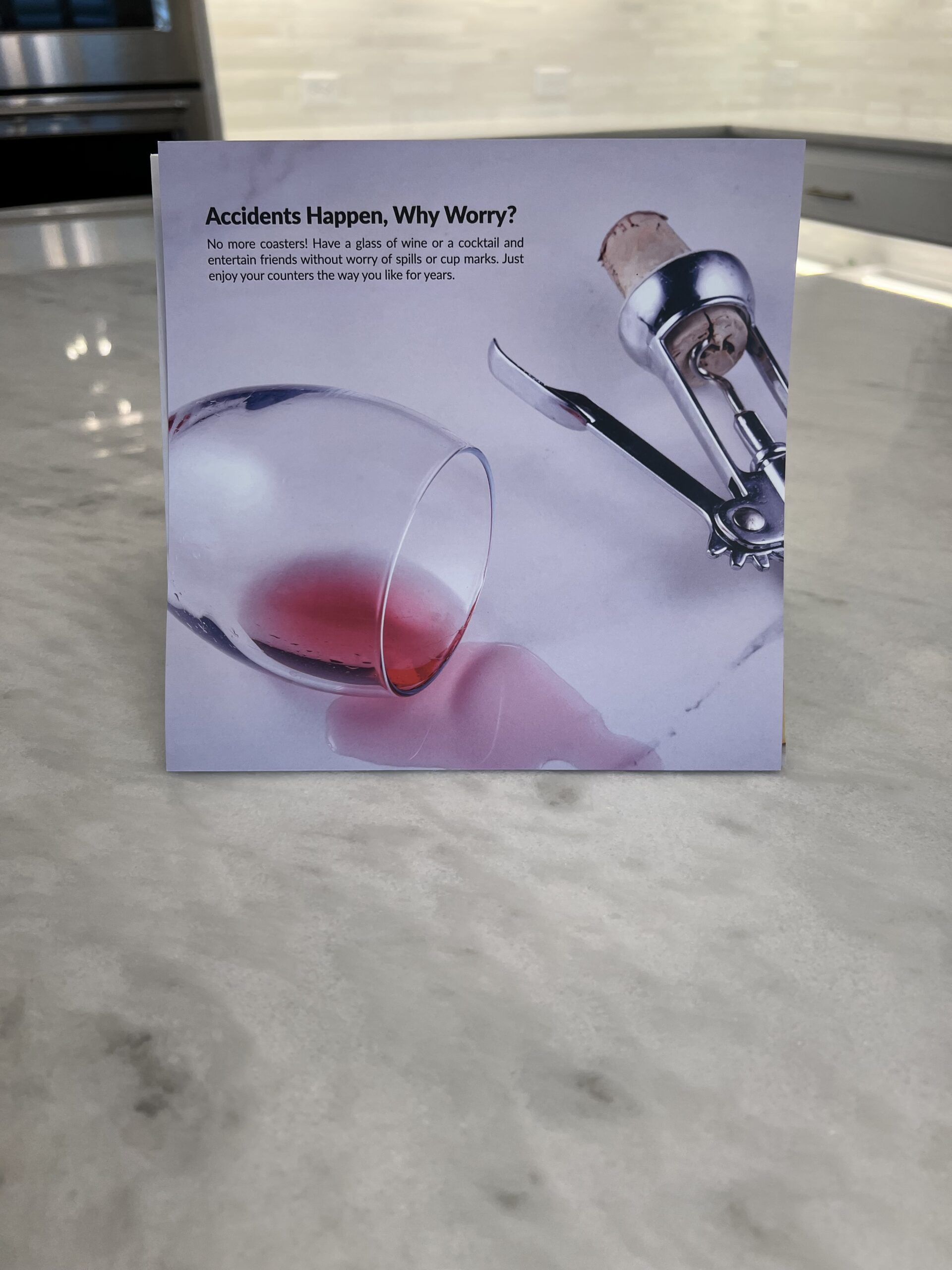
Do you still have to panic when someone spills lemon juice, wine, coffee, or salad dressing?
For many homeowners, these questions determine whether protecting their marble makes sense in the first place.
At Sureshine Care and Restoration Services, Inc., we install MORE® AntiEtch® on marble and other appropriate acid-sensitive natural stone surfaces. One of the biggest advantages of the system isn’t just what happens during installation.
It’s how much easier marble can become to live with afterward.
First, What Is MORE® AntiEtch®?
MORE® AntiEtch® is a clear protective surface designed for marble, limestone, dolomite, and other appropriate acid-sensitive natural stones.
Traditional penetrating sealers work primarily within the pores of the stone to help reduce absorption.
MORE® AntiEtch® works differently.
It creates a protective surface over the stone so common household substances encounter the protection rather than immediately contacting exposed marble.
That distinction matters because marble is primarily composed of calcium carbonate.
Acids react with calcium carbonate.
That’s why substances such as lemon juice, vinegar, wine, tomato products, and many other acidic foods or cleaners can leave dull etch marks on exposed marble.
A traditional penetrating sealer does not change that chemistry.
MORE® AntiEtch® addresses the problem by protecting the surface itself.
MORE® AntiEtch® is designed to last a lifetime and carries a written 10-year stain and etch-free warranty.
Does MORE® AntiEtch® Change How You Live With Marble?
For many homeowners, yes.
Living with unprotected marble often creates habits that people didn’t expect when they selected the stone.
You start watching every glass.
You move the lemon away from the island.
You worry when someone opens a bottle of wine.
You check underneath the coffee maker.
You remind guests to use coasters.
You wipe spills immediately because you’re worried that the next drop may leave another dull spot.
That can become exhausting.
And it is one reason some homeowners eventually regret choosing marble even though they still love how it looks.
MORE® AntiEtch® is intended to change that relationship.
You should still take reasonable care of your countertop, but normal use should not require constant anxiety about etching and staining.
How Do You Clean MORE® AntiEtch®?
Routine cleaning should be simple.
For normal everyday maintenance, remove crumbs and loose debris, then wipe the surface with a clean, soft cloth or microfiber towel.
For routine housekeeping, Sureshine’s maintenance guidance includes a simple 50/50 mixture of isopropyl alcohol and water when appropriate for the protected surface.
This helps remove everyday oils, fingerprints, light residue, and common kitchen contamination without leaving the heavy buildup that some household cleaners can create.
The objective is not to attack the countertop with aggressive chemistry.
It’s to keep the protective surface clean.
Why Don’t You Need Aggressive Cleaners?
People often assume stronger cleaners produce cleaner countertops.
That’s not necessarily true.
In many cases, complicated cleaning products introduce more ingredients than the surface actually needs.
Some products contain:
- Waxes
- Oils
- Polishing agents
- Fragrances
- Surfactants
- Residue-forming additives
Those ingredients may leave a film behind.
Over time, the homeowner may notice streaking, smearing, fingerprints, or a surface that simply doesn’t look as crisp as it once did.
Then more cleaner gets added.
That can create more residue.
Simple maintenance is often better maintenance.
Should You Use Marble Polish on MORE® AntiEtch®?
Not as part of routine cleaning unless a specific maintenance product has been recommended for the protected surface.
Remember that after MORE® AntiEtch® is installed, you’re maintaining the protective surface—not exposed marble.
Products marketed as “marble polish” may be designed for a completely different purpose.
Some are temporary appearance enhancers.
Some leave waxes or films.
Some are intended for uncoated stone.
More product does not automatically mean more shine.
If the surface begins to look different from when it was installed, it is better to determine whether you’re seeing residue, normal wear, scratching, or an actual finish issue before applying additional products.
Does MORE® AntiEtch® Need to Be Resealed?
MORE® AntiEtch® is not maintained like a traditional penetrating sealer.
A penetrating sealer works within porous stone and may eventually require reapplication depending on the product, stone, exposure, and use.
MORE® AntiEtch® is a protective surface system.
You are not simply waiting for an impregnating sealer inside the stone to wear away and then applying another coat.
That is one reason it’s important not to think of MORE® AntiEtch® as just another marble sealer.
It’s a different category of protection.
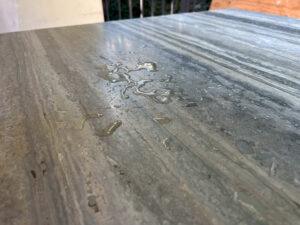
Can You Still Spill Lemon Juice on It?
Protection from etching is one of the primary reasons homeowners choose MORE® AntiEtch®.
On exposed marble, lemon juice can react with the calcium carbonate and leave a dull etch.
With MORE® AntiEtch®, the lemon juice encounters the protective surface rather than immediately reacting with exposed marble.
That doesn’t mean you should intentionally leave lemon juice sitting on the countertop for days.
It means an ordinary kitchen spill no longer needs to create the same level of concern it would on unprotected marble.
Wipe it up as part of normal housekeeping and continue using the kitchen.
What About Wine?
Wine can create two concerns on exposed marble.
It can be acidic enough to contribute to etching, and its pigments can create staining concerns depending on the stone and circumstances.
MORE® AntiEtch® is designed to protect against both staining and etching.
That makes it particularly useful on kitchen islands, bars, dining areas, and other marble surfaces where entertaining is common.
You don’t have to stop serving red wine because you own marble.
What About Coffee?
Coffee is another everyday spill that homeowners worry about.
A coffee cup can drip.
A coffee maker can leak underneath.
A spoon can leave droplets across the counter.
On a protected surface, these become ordinary cleaning events rather than reasons to immediately assume the marble has been permanently changed.
Wipe the surface clean and move on.
What About Tomato Sauce, Citrus, and Salad Dressing?
A working kitchen is full of substances that can create problems for exposed marble.
Tomatoes are acidic.
Citrus is acidic.
Many salad dressings contain vinegar or citrus.
Condiments may contain acids, oils, pigments, or combinations of all three.
This is why marble can become difficult for homeowners who cook frequently.
MORE® AntiEtch® allows the homeowner to use the kitchen more normally without having to memorize the chemistry of every ingredient.
Does That Mean You Can Ignore Spills?
No.
Protection is not a substitute for reasonable housekeeping.
We still recommend wiping up spills.
We still recommend keeping the countertop clean.
We still recommend using cutting boards and trivets where appropriate.
The difference is that everyday use becomes more forgiving.
There’s a big difference between:
“I should wipe that up.”
and
“If I don’t wipe that up in the next five seconds, my marble may be permanently etched.”
That difference is a major part of the value of the system.
Can MORE® AntiEtch® Be Scratched?
Yes.
This is one of the most important expectations to establish.
MORE® AntiEtch® is not indestructible.
It is a working surface.
Anything used as a countertop can experience physical wear.
Dragging abrasive objects across the surface, cutting directly on the countertop, sliding rough-bottomed appliances, or exposing the surface to unusual mechanical abuse can create scratches.
That’s different from etching.
Etching is chemical damage.
Scratching is physical damage.
MORE® AntiEtch® is specifically designed to protect against staining and etching, but normal care is still appropriate for preventing physical damage.
Should You Use a Cutting Board?
Yes.
There are several reasons.
A cutting board protects the countertop from knife contact and physical wear.
It protects your knives.
It keeps food preparation organized.
And it reduces the chance of dragging abrasive material across the countertop.
Having stain and etch protection is not a reason to use the countertop as a cutting board.
What About Hot Pots and Pans?
Use trivets and heat protection as part of normal countertop care.
Even if a surface has good resistance to everyday kitchen conditions, placing extremely hot cookware directly onto a countertop creates unnecessary thermal stress.
There is little downside to using a trivet.
The goal is to protect the entire countertop system—not to find its limits.
Can Heavy Appliances Scratch the Surface?
They can if they are dragged.
Coffee makers, mixers, air fryers, blenders, and other countertop appliances can collect grit underneath their feet.
Dragging that grit across a finished surface can create scratches.
When moving an appliance, lift it rather than sliding it whenever practical.
This is good advice for virtually any premium countertop surface.
What Is Normal Wear?
This is an important distinction.
A countertop is not a museum display.
It’s used.
Over time, high-traffic areas may develop subtle changes in appearance from repeated wiping, sliding objects, and everyday contact.
That does not automatically mean the protection has failed.
Normal wear and stain or etch failure are different conditions.
A kitchen island used by a family every day will naturally experience more physical interaction than a decorative marble console table in a hallway.
The type and degree of maintenance should reflect how the surface is actually used.
What If the Finish Starts Looking Dull?
Don’t immediately assume the MORE® AntiEtch® has failed.
A dull or hazy appearance can have several causes.
It may be:
- Cleaning residue
- Oil buildup
- Hard-water residue
- Fine physical wear
- Scratching
- A change in the finish from repeated use
The first step is determining what is actually on—or happening to—the surface.
Sometimes a proper cleaning is all that’s needed.
Other times professional maintenance may be appropriate.
Can MORE® AntiEtch® Be Professionally Maintained?
Yes.
One of the advantages of the system is that the finished surface can be professionally maintained when appropriate.
A maintenance visit may address appearance changes caused by normal use without requiring the entire installation to be removed and started over.
The appropriate process depends on:
- The existing finish
- The type of wear
- The location of the wear
- Whether physical damage is present
- The overall condition of the protected surface
We sometimes refer to this type of professional maintenance as a tune-up.
What Is a MORE® AntiEtch® Tune-Up?
A tune-up is not the same thing as the original installation.
The original installation involves preparing the marble, applying MORE® AntiEtch®, curing it, and developing the final finish.
A tune-up is maintenance of an existing protected surface.
The exact work depends on what the countertop needs.
For example, the surface may have accumulated fine wear or appearance inconsistencies that can be professionally refined.
Because the protection is already installed, the process can be significantly different from starting with exposed marble.
Do Faucets Have to Be Removed for Maintenance?
Not necessarily.
During the original residential MORE® AntiEtch® installation, faucet removal is commonly required because the marble underneath and immediately around the fixture openings needs to be properly prepared and protected.
A maintenance tune-up is different.
When we’re maintaining an existing protected surface rather than performing the original installation, faucet removal may not be necessary.
The exact approach depends on the condition and location of the work.
Does Matte MORE® AntiEtch® Wear Differently Than Polished?
Every finish interacts with light differently.
A polished surface has a high degree of reflection, so fine scratches or residue may be more noticeable under certain lighting.
A matte finish intentionally has very little reflection, so the appearance of wear may present differently.
A satin finish falls between the two.
None is automatically “better.”
The right finish depends on the stone, design, lighting, and homeowner preference.
MORE® AntiEtch® can be finished in:
- Matte
- Satin
- Polished
That allows the protection to complement the design rather than forcing every countertop into the same appearance.
Can You Change the Finish Later?
Depending on the condition and installation, professional refinishing may allow the appearance of the protected surface to be adjusted.
Because finish development is a mechanical process, there may be options for changing how reflective the surface appears.
That should be evaluated professionally rather than attempted with household polishing products.
What Happens If One Small Area Gets Damaged?
Not every problem means the entire kitchen needs to be redone.
If physical damage occurs in a localized area, the first step is to evaluate:
- How deep the damage is
- Whether the protection has been compromised
- Whether the marble underneath has been affected
- How the repair will blend with the surrounding finish
Localized professional repair or maintenance may be possible depending on the circumstances.
The key is not to experiment with aggressive sanding, polishing compounds, or chemicals before the area is evaluated.
What Should You Do If You Accidentally Scratch It?
First, don’t panic.
Second, don’t immediately start sanding it.
A small mark that appears dramatic under certain lighting may be relatively minor.
Trying to repair it with household abrasives can enlarge the affected area and make professional blending more difficult.
Clean the area normally, inspect it under several lighting conditions, and contact your installer if the scratch remains significant.
What Should Housekeepers Know?
This is particularly important in homes where several people maintain the kitchen.
A beautifully maintained surface can become frustrating if every housekeeper uses a different product.
We recommend keeping the instructions simple and consistent.
The person cleaning the countertop should understand:
- Which routine cleaner is recommended
- That abrasive pads should not be used
- That aggressive specialty chemicals are unnecessary
- That waxes and appearance-enhancing products should not be added without a reason
- That spills should still be wiped up normally
For routine housekeeping, Sureshine commonly specifies a 50/50 isopropyl alcohol and water solution for appropriate MORE® AntiEtch® surfaces.
Simple instructions reduce mistakes.
Can You Use Disinfectants?
Homeowners often want to disinfect kitchen or bathroom surfaces.
Because disinfectant formulations vary, we don’t recommend assuming that every product is appropriate simply because it is sold for countertop use.
Follow the maintenance guidance provided for the installation, and contact your installer before introducing aggressive or unfamiliar chemicals into the routine.
There is usually no benefit to creating a complicated chemical maintenance program when simple cleaning is sufficient.
What About Bathroom Vanities?
The maintenance philosophy is similar.
Bathroom vanities experience a different group of products:
- Toothpaste
- Cosmetics
- Skincare products
- Fragrances
- Hair products
- Soaps
- Cleaners
Many of these can create staining or etching concerns on exposed marble.
Once MORE® AntiEtch® is installed, routine maintenance becomes much simpler.
Keep the surface clean, remove spills and product residue, and avoid unnecessary abrasion.
Does MORE® AntiEtch® Require Special Annual Service?
There is not a universal rule that every protected countertop must receive professional service every year.
Usage varies too much.
A lightly used bathroom vanity and a heavily used family kitchen island are completely different environments.
Professional maintenance should be based on condition rather than an arbitrary calendar date.
If the surface still looks and performs properly, there may be nothing that needs to be done beyond routine cleaning.
How Long Is MORE® AntiEtch® Designed to Last?
MORE® AntiEtch® is designed to last a lifetime and carries a written 10-year stain and etch-free warranty.
That does not mean the surface can never experience physical wear or damage.
The distinction matters.
Staining and etching are specific performance concerns.
Scratching, impact, cutting, abrasion, or other physical damage are different.
A homeowner should understand both the protection provided and the reasonable care expected of any premium finished surface.
Why Warranty Language Matters
We prefer homeowners understand what a warranty actually means rather than simply hearing the word “warranty.”
A written stain and etch-free warranty provides protection related to the performance the system was designed to deliver.
It is not a promise that nothing can ever physically happen to the countertop.
If someone strikes the edge with a heavy object, cuts directly on the surface, or severely scratches it, that is a different type of event.
Clear expectations make for much happier long-term ownership.
Can MORE® AntiEtch® Be Removed?
MORE® AntiEtch® is intended as a long-term protective solution, not a temporary topical treatment that is routinely stripped and reapplied.
If a future project requires major alteration, repair, or removal, the surface should be evaluated by a qualified professional.
This isn’t something we recommend approaching as a DIY coating-removal project.
Why Proper Installation Matters to Long-Term Maintenance
Maintenance begins with installation.
A properly prepared surface provides the foundation for long-term performance.
Sureshine’s installation process includes:
- Evaluation — assessing the marble, existing etching, scratches, seams, and condition.
- Masking — protecting surrounding cabinets, floors, appliances, walls, and fixtures.
- Preparation — mechanically refining the marble to a low, even hone, removing existing etches and scratches, and addressing seams where appropriate.
- Application — applying MORE® AntiEtch® and allowing it to properly level.
- UV Curing — curing the material using proprietary ultraviolet technology.
- Finishing — mechanically refining the cured surface to the selected matte, satin, or polished finish.
- Detailing — completing edges, transitions, surrounding areas, and final cleanup.
- Ready for Use — once installation is complete, the protected surface is ready for use, with plumbing fixtures reinstalled by the appropriate professional where removal was required.
If the preparation is rushed, the consequences may not appear until later.
That’s why long-term care starts before the protective material is ever applied.
Does MORE® AntiEtch® Make Marble Maintenance-Free?
No.
We don’t believe “maintenance-free” is a useful promise for a surface that people cook on, eat on, clean, touch, and use every day.
A better description is lower-stress marble ownership.
You still clean it.
You still use cutting boards.
You still avoid dragging abrasive objects.
You still take reasonable care of it.
But you don’t have to treat every lemon wedge like an emergency.
That’s a very different way to live with marble.
Why MORE® AntiEtch® Makes Sense in Southlake Homes
Many Southlake homes feature large kitchens designed around entertaining and everyday family life.
Marble may be used across oversized islands, perimeter countertops, bars, butler’s pantries, and bathroom vanities.
Those surfaces are meant to be used.
A beautiful marble island loses some of its appeal if everyone in the house is afraid to put anything on it.
MORE® AntiEtch® allows homeowners to choose marble for its natural beauty while reducing one of the material’s biggest maintenance concerns.
And once the system is installed, the ongoing care is relatively straightforward.
What Should You Remember About MORE® AntiEtch® Care?
If you remember nothing else, remember these basics:
- Keep the surface clean.
- Use the maintenance method recommended for your installation.
- A 50/50 isopropyl alcohol and water solution is commonly used by Sureshine for routine housekeeping on appropriate MORE® AntiEtch® surfaces.
- Use soft microfiber cloths rather than abrasive pads.
- Wipe spills normally.
- Use cutting boards.
- Use trivets for hot cookware.
- Lift heavy appliances rather than dragging them.
- Don’t apply random waxes or polishing products.
- Don’t attempt DIY sanding if the surface becomes scratched.
- Call for professional maintenance when the condition actually warrants it.
That’s not a complicated maintenance program.
And that’s the point.
MORE® AntiEtch® Installation and Maintenance in Southlake, Texas
If you already have MORE® AntiEtch® and have questions about cleaning or maintaining the surface, Sureshine can help evaluate its condition and recommend the appropriate care.
If you’re considering MORE® AntiEtch® for an existing or newly installed marble countertop, we can also explain the entire process—from marble preparation through UV curing, final finish, and long-term maintenance.
MORE® AntiEtch® is designed to last a lifetime and carries a written 10-year stain and etch-free warranty.
The objective is not to turn marble into an indestructible material.
It’s to let you enjoy the marble you chose without constantly worrying about the next etch mark.
Call Sureshine: (714) 627-9001
Schedule a Free Consultation: Request a MORE® AntiEtch® Evaluation
Learn more about MORE® AntiEtch® marble countertop protection.
If you’re outside Sureshine’s service area, visit the Sureshine Service Network to locate qualified MORE® AntiEtch® service options in other markets.
Frequently Asked Questions About MORE® AntiEtch® Cleaning and Maintenance
What should I use to clean MORE® AntiEtch® every day?
Routine maintenance should be simple. Remove loose debris and wipe the surface using a clean, soft microfiber cloth. For appropriate MORE® AntiEtch® surfaces, Sureshine commonly recommends a 50/50 mixture of isopropyl alcohol and water for routine housekeeping. Follow the specific maintenance instructions provided for your installation.
Do I still need to wipe up lemon juice and wine immediately?
You should wipe spills as part of normal housekeeping, but MORE® AntiEtch® is specifically designed to protect against staining and etching. The purpose is to eliminate the panic associated with ordinary acidic spills on exposed marble. A spill should become a cleaning event rather than an automatic restoration problem.
Does MORE® AntiEtch® need to be resealed every year?
MORE® AntiEtch® is not a traditional penetrating stone sealer and should not be treated as one. Routine annual reapplication of penetrating sealer is not the maintenance model for the protected surface. Professional maintenance should be based on the actual condition of the installation.
Can I use regular marble cleaner on MORE® AntiEtch®?
Do not assume every product labeled “marble cleaner” is necessary or ideal for a protected surface. Some products may leave residue, waxes, or appearance-enhancing ingredients behind. Use the maintenance method recommended for the installation rather than continually adding products because they have the word marble on the label.
Can MORE® AntiEtch® scratch?
Yes. MORE® AntiEtch® provides stain and etch protection, but it is still a finished working surface. Cutting directly on it, dragging abrasive objects, or exposing it to physical abuse can create scratches. Cutting boards, trivets, and reasonable countertop care are still recommended.
What should I do if I scratch the surface?
Clean the area normally and avoid immediately trying to sand or polish the scratch yourself. Household abrasives can enlarge a small problem and make blending more difficult. If the mark remains noticeable, have the surface professionally evaluated to determine whether maintenance or localized repair is appropriate.
Can a scratched area be repaired without redoing the whole kitchen?
Depending on the location, depth, finish, and extent of the damage, localized professional repair or refinement may be possible. Not every scratch requires complete replacement or reinstallation of the protective system. The area should be evaluated before deciding on the appropriate process.
What is an AntiEtch® tune-up?
A tune-up is professional maintenance of an existing MORE® AntiEtch® surface. It is different from the original installation because the protection is already in place. Depending on the condition, a tune-up may address fine wear, appearance inconsistencies, or other maintenance needs. The exact process is determined by the existing finish and type of wear.
Do my faucets need to be removed for an AntiEtch® tune-up?
Not necessarily. Faucet removal is commonly part of the original residential installation because the marble around and underneath fixture openings needs proper preparation and protection. A maintenance tune-up may not require faucet removal because the protected surface is already installed. The condition and location of the work determine the approach.
Does a polished finish require more maintenance than matte?
Not necessarily more maintenance, but the appearance of wear can differ. A polished finish reflects more light, which can make fine scratches, residue, or fingerprints easier to notice under certain lighting. Matte and satin finishes interact with light differently. The best finish should be selected based on appearance preference, use, stone, and design.
Can my housekeeper use disinfectant on MORE® AntiEtch®?
Because disinfectant formulations vary, don’t assume every disinfectant or specialty cleaner is appropriate. Follow the maintenance instructions provided for the installation. If there is a specific product you want to introduce into the cleaning routine, verify compatibility before making it a regular part of maintenance.
How often should MORE® AntiEtch® receive professional maintenance?
There is no single schedule that applies to every countertop. A heavily used kitchen island experiences different wear than a guest bathroom vanity. Professional maintenance should be based on the condition of the surface rather than an arbitrary annual schedule. If the finish still looks and performs properly, routine cleaning may be all that is necessary.
Is MORE® AntiEtch® maintenance-free?
No countertop surface is truly maintenance-free. MORE® AntiEtch® still needs routine cleaning and reasonable physical care. Its major advantage is that marble becomes much easier to live with because staining and etching are addressed by the protective system rather than requiring the homeowner to constantly protect exposed calcium-based stone from everyday spills.
How long is MORE® AntiEtch® designed to last?
MORE® AntiEtch® is designed to last a lifetime and carries a written 10-year stain and etch-free warranty. Physical wear, scratches, impacts, or abuse are different from staining and etching and should be treated as separate maintenance or repair issues.