Why Marble Bathroom Vanities Etch: Cosmetics, Cleaners, and the Case for MORE® AntiEtch®
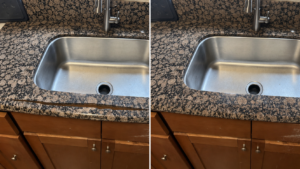
A few pale spots are scattered near the faucet.
Something that looks like a drip runs down the backsplash.
You clean it.
Nothing happens.
You clean it again.
Still there.
So you try a stronger cleaner.
And now the area looks even worse.
This is one of the most common misunderstandings homeowners have about marble bathroom countertops.
The mark may not be dirt.
It may not be a water spot.
It may not even be a stain.
The marble may be etched.
At Sureshine Care and Restoration Services, Inc., we restore and protect marble countertops throughout Corona del Mar, Newport Beach, Orange County, and Southern California, and bathrooms present a very different set of challenges from kitchens.
People naturally associate marble etching with lemons, vinegar, and wine.
But bathrooms contain their own collection of products that can affect acid-sensitive natural stone.
And because many of those products are used every single day, a beautiful marble vanity can gradually become covered with dull spots, rings, drips, and inconsistent areas.
Why Is Marble So Popular in Bathrooms?
There is a reason designers continue using marble in high-end bathrooms.
Few materials create the same combination of elegance and natural character.
Marble can be used for:
- Vanity countertops
- Backsplashes
- Shower walls
- Shower benches
- Tub surrounds
- Floors
- Decorative details
White marbles can make a bathroom feel bright and open.
Darker marbles can create dramatic contrast.
Veined marble gives every installation an individual character that manufactured surfaces attempt to reproduce but never duplicate exactly.
But natural beauty comes with natural chemistry.
Understanding that chemistry is the key to maintaining marble successfully.
Why Does Marble Etch?
Marble is primarily composed of calcium carbonate.
Calcium carbonate reacts with acids.
When an acidic substance contacts exposed marble, a chemical reaction can alter the surface of the stone.
That change is called etching.
On polished marble, an etch commonly appears as a dull spot because the affected area no longer reflects light the same way as the surrounding polished surface.
On honed marble, the damage may be less dramatic, but the chemical reaction can still occur.
This is important:
Honing marble does not make it acid resistant.
It simply changes the finish.
What Is Etching on a Bathroom Vanity?
An etch can take several forms.
You may see:
- Dull rings
- Pale spots
- Drip marks
- Cloudy areas
- Loss of reflection
- Irregular patches around the sink
Sometimes the damage is obvious.
Other times you only see it when sunlight or bathroom lighting hits the countertop at a certain angle.
That often leads homeowners to assume the surface simply needs a better cleaning.
But cleaning cannot remove an etch.
The surface itself has changed.
Etching and Staining Are Not the Same Thing
This distinction is important because homeowners frequently describe every mark on marble as a stain.
A stain generally occurs when a substance penetrates into the stone and causes discoloration.
An etch occurs when a chemical reaction changes the stone’s surface.
One is primarily an absorption problem.
The other is a surface chemistry problem.
Sometimes both can occur in the same area.
And because they have different causes, they require different solutions.
What Bathroom Products Can Affect Marble?
A bathroom vanity may be exposed to dozens of different products every week.
Depending on their chemistry, concentration, and contact time, potentially problematic products can include:
- Facial cleansers
- Skincare products
- Acne treatments
- Exfoliating products
- Cosmetics
- Hair products
- Toothpaste
- Mouth-care products
- Fragrances
- Bathroom cleaners
- Descaling products
- Some soaps
Not every product in these categories will damage marble.
Formulations vary enormously.
But that’s part of the problem.
Most homeowners aren’t checking the chemistry of every bottle before setting it on the vanity.
Skincare Has Changed—and Marble Notices
Modern skincare routines can involve significantly more products than they did a generation ago.
A bathroom counter may contain:
- Serums
- Toners
- Vitamin-based treatments
- Exfoliants
- Cleansers
- Masks
- Spot treatments
- Moisturizers
Some skincare formulations intentionally use acidic ingredients because those ingredients serve a purpose on skin.
The fact that a product is appropriate for your face does not mean it is appropriate for exposed marble.
A few drops can run down a bottle, collect underneath it, and remain against the stone until the next morning.
When the bottle is moved, a dull ring may be waiting underneath.
Why Do Bottles Leave Rings on Marble?
This is one of the classic bathroom vanity problems.
A bottle doesn’t have to spill dramatically.
A small amount of product can travel down the outside of the container and collect along its bottom edge.
The bottle then holds the liquid against the marble.
Instead of being wiped away immediately, the product may remain there for hours.
The next time the bottle is picked up, the homeowner discovers a perfect circle or partial ring.
If the substance chemically reacted with the marble, wiping harder won’t remove it.
Why Are There Dull Spots Around the Faucet?
Not every dull area around a faucet is an etch.
Water can leave mineral deposits.
Soap can leave residue.
Cleaning products can build up.
But etching is also possible.
The challenge is that mineral deposits and etched marble can sometimes exist in the same area.
A homeowner sees a cloudy surface and assumes it needs something stronger to dissolve the buildup.
If that stronger product is acidic, the cleaner can remove the mineral deposit while simultaneously etching the marble underneath.
Now the deposit is gone, but the countertop still looks dull.
Sometimes it looks worse.
Why Bathroom Cleaners Can Be a Problem
Bathrooms naturally develop mineral deposits, soap residue, and other buildup.
Many bathroom cleaners are formulated to attack those materials aggressively.
That’s useful on surfaces designed to tolerate the chemistry.
It can be a problem on marble.
Products intended to remove:
- Hard-water deposits
- Calcium buildup
- Soap scum
- Mineral scale
may contain acids or other ingredients that should not be assumed safe for calcium-based natural stone.
The irony is easy to see.
Marble itself contains calcium.
A cleaner designed to chemically attack calcium deposits may also react with the marble surface.
Can Vinegar Be Used on a Marble Vanity?
No.
Vinegar is acidic.
It’s frequently promoted as a natural household cleaner, but “natural” and “safe for marble” are not the same thing.
Vinegar can react with calcium carbonate and etch marble.
The same caution applies to DIY cleaning mixtures that contain lemon juice or other acids.
A cleaning recipe can work beautifully on one household surface and damage another.
Does Sealing Marble Prevent Bathroom Etching?
This is where many homeowners become confused.
They were told the marble was sealed.
Then dull spots appeared.
So they assume the sealer failed.
Usually, that’s not what happened.
Traditional penetrating or impregnating stone sealers are primarily designed to reduce absorption.
They can help provide resistance against certain staining substances by slowing their penetration into the stone.
But they do not normally create an acid-resistant protective layer over the marble.
The surface remains exposed.
Acid can still contact the marble.
And the marble can still etch.
You can learn more about professional marble sealing and what penetrating sealers are actually designed to do.
Why Doesn’t Another Coat of Sealer Solve the Problem?
Because etching and staining are different problems.
If the objective is reducing absorption, an appropriate penetrating sealer may be part of the solution.
If the objective is preventing acidic products from contacting the marble itself, you need a different type of protection.
Adding more penetrating sealer doesn’t change the fundamental chemistry of marble.
That’s where MORE® AntiEtch® changes the conversation.
What Is MORE® AntiEtch®?
MORE® AntiEtch® is a clear protective surface designed to help protect acid-sensitive natural stone from staining and etching.
Instead of relying solely on protection within the pores of the stone, MORE® AntiEtch® creates protection over the marble surface.
That means everyday products encounter the protective surface rather than immediately contacting exposed marble.
For a bathroom vanity that may see cosmetics, skincare, toothpaste, cleaners, fragrances, and other products every day, that can make a substantial difference in how easy the marble is to live with.
MORE® AntiEtch® is designed to last a lifetime and carries a written 10-year stain and etch-free warranty.
Why Bathroom Vanities Are Such a Good Candidate for MORE® AntiEtch®
Think about how a bathroom vanity is actually used.
It’s rarely empty.
Bottles sit on it.
People brush their teeth over it.
Makeup gets applied over it.
Skincare products are opened and closed over it.
Hands are wet.
Products drip.
Cleaning happens frequently.
In a primary bathroom shared by two people, that activity may happen several times every day.
The marble doesn’t get much of a break.
Protecting the surface allows the vanity to function more like the working surface it actually is.
Can MORE® AntiEtch® Be Used on a New Marble Vanity?
Yes.
In fact, installing MORE® AntiEtch® before the marble accumulates years of etching can make excellent sense.
New marble can be evaluated, properly prepared, and protected before the bathroom enters full everyday use.
That can be particularly convenient during a remodel or new construction project when other trades are already coordinating access to the space.
New marble still requires proper evaluation and preparation.
“New” doesn’t automatically mean the surface is ready for protection.
What If My Marble Vanity Is Already Etched?
That doesn’t necessarily prevent it from being protected.
Existing etching, scratches, and appropriate surface damage can often be addressed during preparation.
The marble is mechanically refined before MORE® AntiEtch® is applied.
This allows us to restore the surface rather than simply trapping the old damage underneath the protection.
If protection isn’t being installed, existing marble etching can also be addressed through professional marble countertop honing and polishing.
Why Polishing Alone Doesn’t Prevent the Next Etch
Professional polishing can restore the appearance of etched marble.
But it doesn’t change what marble is made of.
Imagine a vanity with twenty etches.
We hone and polish the marble.
The etches are removed or significantly improved.
The vanity looks beautiful again.
Then the next morning someone places the same acidic skincare bottle back in the same place.
The exposed marble is still calcium based.
Another etch can occur.
Restoration corrects existing damage.
Surface protection changes how the marble encounters future spills.
How Sureshine Installs MORE® AntiEtch® on a Marble Vanity
A professional installation involves a controlled process designed around the specific countertop.
1. Evaluation
We inspect the marble, existing finish, etches, scratches, seams, backsplash transitions, faucet areas, previous treatments, and overall condition.
2. Masking and Protection
Bathroom vanities sit next to cabinetry, mirrors, painted walls, sinks, plumbing fixtures, backsplashes, floors, and other finished materials.
These surrounding areas are carefully protected before preparation begins.
3. Surface Preparation
The marble is mechanically refined to a low, even hone.
Honing is essentially precision sanding with professional abrasives.
This creates the appropriate surface for bonding while allowing us to remove existing etching, scratches, and appropriate surface imperfections.
Seams and transitions are addressed where necessary.
4. MORE® AntiEtch® Application
The protective material is professionally applied to the prepared marble and allowed to level across the surface.
5. UV Curing
The material is cured using proprietary UV-light technology.
This creates the durable protective surface.
6. Finish Customization
After curing, the surface is sanded and refined to create the desired matte, satin, or polished finish.
7. Final Detailing
The vanity, edges, transitions, backsplash areas, and surrounding work area are carefully detailed.
8. Ready for Use
After the installation process is complete, the protected surface is ready for use.
Where faucets have been removed to allow proper preparation and protection around the fixture openings, they will need to be reinstalled by the appropriate plumbing professional.
Why Would the Faucets Need to Come Off?
This is an important detail in residential bathroom installations.
If a faucet is mounted directly through the marble, the stone underneath the fixture cannot be properly prepared or protected while the faucet remains in place.
Trying to work around the fixture can leave an unprotected perimeter immediately beside one of the wettest areas on the vanity.
For a complete installation, faucet removal is commonly part of the planning process.
The plumbing work should be performed by the appropriate trade.
Will MORE® AntiEtch® Make My Marble Vanity Look Coated?
Homeowners often ask this because they selected natural stone specifically for its appearance.
They don’t want to lose the character of the marble.
The veins should still be visible.
The color variation should still be visible.
The natural movement should still define the countertop.
After curing, MORE® AntiEtch® is mechanically refined to develop the desired finish rather than simply being left as an untouched coating.
The goal is to protect the marble while maintaining the visual character that made you choose the stone in the first place.
Can the Finish Be Honed Instead of Polished?
Yes.
MORE® AntiEtch® can be finished in:
- Matte
- Satin
- Polished
This is particularly useful in bathrooms because many designers intentionally select a softer honed or satin appearance rather than a highly reflective polish.
The protection doesn’t require you to abandon the design aesthetic of the room.
What About Toothpaste?
Toothpaste is one of those products homeowners rarely think about in relation to natural stone.
But toothpaste formulations vary, and the vanity around a sink is constantly exposed to splashes and residue from daily oral care.
Rather than trying to memorize which individual toothpaste, mouth rinse, or dental product may interact with the stone, surface protection creates a much simpler maintenance environment.
That is one of the practical advantages of MORE® AntiEtch®.
What About Perfume and Cologne?
Fragrance products contain complex formulations, often including alcohols, oils, and other ingredients.
The larger issue is that bottles can drip, leak, or hold residue underneath them.
Any product left sitting against porous natural stone for an extended period can create concern depending on its chemistry.
Keeping bottles organized on trays can help reduce direct exposure even when the marble is protected.
Can Makeup Stain Marble?
Some cosmetics contain pigments, oils, and other ingredients that may discolor porous surfaces if allowed to penetrate.
This is where staining and etching need to be considered separately.
A pigmented cosmetic may present an absorption concern.
Another product may present an etching concern.
MORE® AntiEtch® is designed to provide protection against both staining and etching, which is particularly useful on a bathroom countertop exposed to many different product types.
Why Are Marble Backsplashes Important Too?
Drips don’t always stay on the horizontal countertop.
Products can splash onto the backsplash.
Cleaners can be sprayed across the entire vanity area.
Water can run along transitions.
When evaluating a marble vanity, we look at how the entire installation is used rather than assuming only the flat countertop is exposed.
The exact areas appropriate for protection depend on the design and accessibility of the installation.
What About Marble Shower Benches?
Marble shower benches face a different environment than vanity countertops.
They are repeatedly exposed to water, soaps, shampoos, personal-care products, minerals, and cleaning products.
Shower installations also involve moisture-management considerations that don’t exist on a typical vanity.
For that reason, shower stone should be evaluated as its own system rather than assuming every marble surface in a bathroom should receive exactly the same treatment.
Why Does My Housekeeper Keep Getting Blamed for the Marble?
This happens more often than it should.
The homeowner sees dull areas after cleaning and assumes the housekeeper damaged the marble.
Sometimes an inappropriate cleaner was used.
But sometimes the etching was already present from everyday products and only became noticeable after the countertop was cleaned.
The better solution is education.
Anyone maintaining marble should know:
- What products are appropriate
- What products should be avoided
- That etching is different from staining
- That stronger cleaning isn’t always better
A protected surface can reduce the consequences of some mistakes, but good maintenance practices are still worthwhile.
Does MORE® AntiEtch® Mean the Countertop Is Indestructible?
No.
And we don’t describe it that way.
A protected countertop can still be physically scratched or damaged through inappropriate use, severe impact, cutting, abrasion, or other outside forces.
MORE® AntiEtch® is specifically designed to address staining and etching.
Normal care is still appropriate.
Think of the protection as making marble much more practical—not turning it into something that can never be damaged.
How Do You Clean a Marble Vanity After MORE® AntiEtch®?
Routine maintenance should still be simple and sensible.
Wipe up spills.
Keep the surface clean.
Use appropriate maintenance products.
Avoid unnecessary abrasive scrubbing.
And don’t use harsh chemicals simply because the surface is protected.
The goal is to make the bathroom easier to maintain, not to create a reason to abuse the finish.
What If MORE® AntiEtch® Eventually Shows Wear?
Bathroom vanities are working surfaces.
Over time, any high-use surface can develop normal wear.
One advantage of MORE® AntiEtch® is that the protective surface can be professionally maintained or tuned up when appropriate.
The exact service depends on the condition, finish, and type of wear.
This is different from assuming the entire system must be replaced whenever the appearance eventually needs attention.
Is MORE® AntiEtch® Worth It on a Small Bathroom Vanity?
Size isn’t the only consideration.
Sometimes a smaller vanity experiences more concentrated use than a large kitchen island.
If every bottle, toothbrush, cosmetic, and cleaning product is used within a few square feet of marble, the exposure can be substantial.
The better questions are:
How is the vanity used?
How much will etching bother you?
How valuable is the marble to the design of the room?
And do you want to maintain exposed marble traditionally, or would you rather protect the surface?
Is MORE® AntiEtch® Necessary for Everyone?
No.
Some homeowners are comfortable with natural marble developing patina.
They expect dull spots and surface changes and see them as part of living with natural stone.
Others want the vanity to maintain a much more consistent appearance.
Neither preference is wrong.
The mistake is installing marble without understanding how it behaves and then being disappointed when normal chemistry does exactly what chemistry does.
Knowing your options allows you to choose the maintenance philosophy that fits you.
Why This Matters in Corona del Mar Homes
Bathrooms in Corona del Mar homes often feature carefully selected natural materials.
Marble may be coordinated across vanities, floors, showers, architectural details, and custom cabinetry.
In those spaces, the countertop isn’t an isolated utility surface.
It’s part of the overall design.
That makes it especially frustrating when a beautiful marble vanity begins developing rings and dull areas within months of installation.
Surface protection gives homeowners another option.
Instead of choosing between beautiful marble and easy maintenance, MORE® AntiEtch® can make natural stone significantly easier to live with in a high-use bathroom.
Restore First or Protect First?
If the marble is new and in excellent condition, protecting it before substantial damage develops can make sense.
If the marble is already etched and scratched, restoration can be incorporated into the preparation process before protection is applied.
Either way, the objective is the same:
Start with a properly prepared marble surface and then protect it from the staining and etching that can occur during everyday bathroom use.
Marble Vanity Protection in Corona del Mar, California
If your marble bathroom vanity is already covered with dull rings, drips, or etched areas, don’t assume it simply needs a stronger cleaner.
And if you’re installing new marble, you don’t have to wait for those marks to appear before considering protection.
Sureshine Care and Restoration Services, Inc. can evaluate the marble, identify existing surface damage, explain restoration options, and determine whether MORE® AntiEtch® is appropriate for your bathroom.
MORE® AntiEtch® is designed to last a lifetime and carries a written 10-year stain and etch-free warranty.
Call Sureshine: (714) 627-9001
Schedule a Free Estimate: Request a Marble Vanity Evaluation
Frequently Asked Questions About Marble Bathroom Vanities and MORE® AntiEtch®
Why does my marble bathroom counter have dull rings around bottles?
Liquid can run down the outside of skincare, cosmetic, or personal-care bottles and become trapped between the bottom of the container and the marble. If the product contains ingredients capable of reacting with calcium carbonate, prolonged contact can etch the surface. Once the marble has chemically changed, normal cleaning will not remove the dull ring. The surface needs to be professionally refinished or otherwise restored.
How can I tell whether a mark on my marble vanity is an etch or a stain?
An etch generally changes the surface finish and may appear duller or lighter when viewed under reflected light. A stain generally changes the color of the stone because material has penetrated into it. However, bathroom vanities can have etching, staining, mineral deposits, and product residue in the same area. Professional evaluation is helpful when the cause isn’t obvious.
Why won’t marble sealer stop etching?
Traditional penetrating sealers primarily reduce absorption into porous stone. They can be very useful for stain resistance, but they do not normally create an acid-resistant layer over the marble. Because the marble surface remains exposed, acidic substances can still react with calcium carbonate and cause etching. MORE® AntiEtch® takes a different approach by creating a protective surface over the stone.
Can I use hard-water remover on my marble vanity?
Do not assume a hard-water or calcium-removing product is safe for marble. Many products designed to dissolve mineral deposits use chemistry that can also react with calcium-based natural stone. If mineral buildup exists on marble, the deposit and underlying stone should be treated with a process appropriate for the specific condition rather than automatically using a strong descaling product.
Can MORE® AntiEtch® be installed on a vanity that is already badly etched?
Often, yes. Existing etching and appropriate surface damage can be addressed during preparation. Sureshine mechanically refines the marble to create the proper surface for the protective system, which also provides an opportunity to remove or reduce existing etches and scratches. The objective is to restore the marble first rather than simply covering damaged stone.
Does the faucet have to be removed?
For many residential vanity installations, faucet removal is appropriate because the marble underneath and immediately surrounding the fixture needs to be properly prepared and protected. Leaving the faucet in place can prevent complete access to the stone. Plumbing disconnection and reinstallation should be coordinated with the appropriate plumbing professional.
Can MORE® AntiEtch® have a honed finish?
Yes. MORE® AntiEtch® can be finished in matte, satin, or polished appearances. This is particularly useful for bathrooms where a designer or homeowner wants to preserve the softer visual character of honed marble while gaining protection against staining and etching.
Will MORE® AntiEtch® hide the natural veining in my marble?
The objective is to preserve the visual character of the natural stone. The marble’s color, veining, movement, and variation remain important parts of the finished appearance. After curing, the protective surface is mechanically refined to achieve the desired finish rather than simply being left as-applied.
Can cosmetics stain marble even if they don’t etch it?
Potentially. Some cosmetics contain pigments, oils, or other ingredients that can create staining concerns on porous surfaces. A product does not have to be acidic to cause a problem. This is why stain resistance and etch resistance are separate considerations when protecting a marble bathroom countertop.
Should I protect a brand-new marble vanity before I start using it?
If etching and staining would bother you, before heavy everyday use begins can be an excellent time to consider MORE® AntiEtch®. New marble still needs to be inspected and properly prepared, but protecting the surface early avoids intentionally waiting for damage to accumulate before deciding to address the problem.
Can I just have etched marble polished instead?
Yes, professional honing and polishing can restore many etched marble surfaces. But polishing corrects the damage that already exists; it doesn’t make exposed marble acid resistant. If the same products contact the restored marble afterward, new etches can develop. MORE® AntiEtch® is an option for homeowners who want to address future staining and etching rather than repeatedly restoring the exposed surface.
How long does MORE® AntiEtch® last?
MORE® AntiEtch® is designed to last a lifetime and carries a written 10-year stain and etch-free warranty. Like any working surface, it should still be properly maintained, and physical wear or damage may occasionally require professional attention. Sureshine can explain maintenance and warranty details during your consultation.