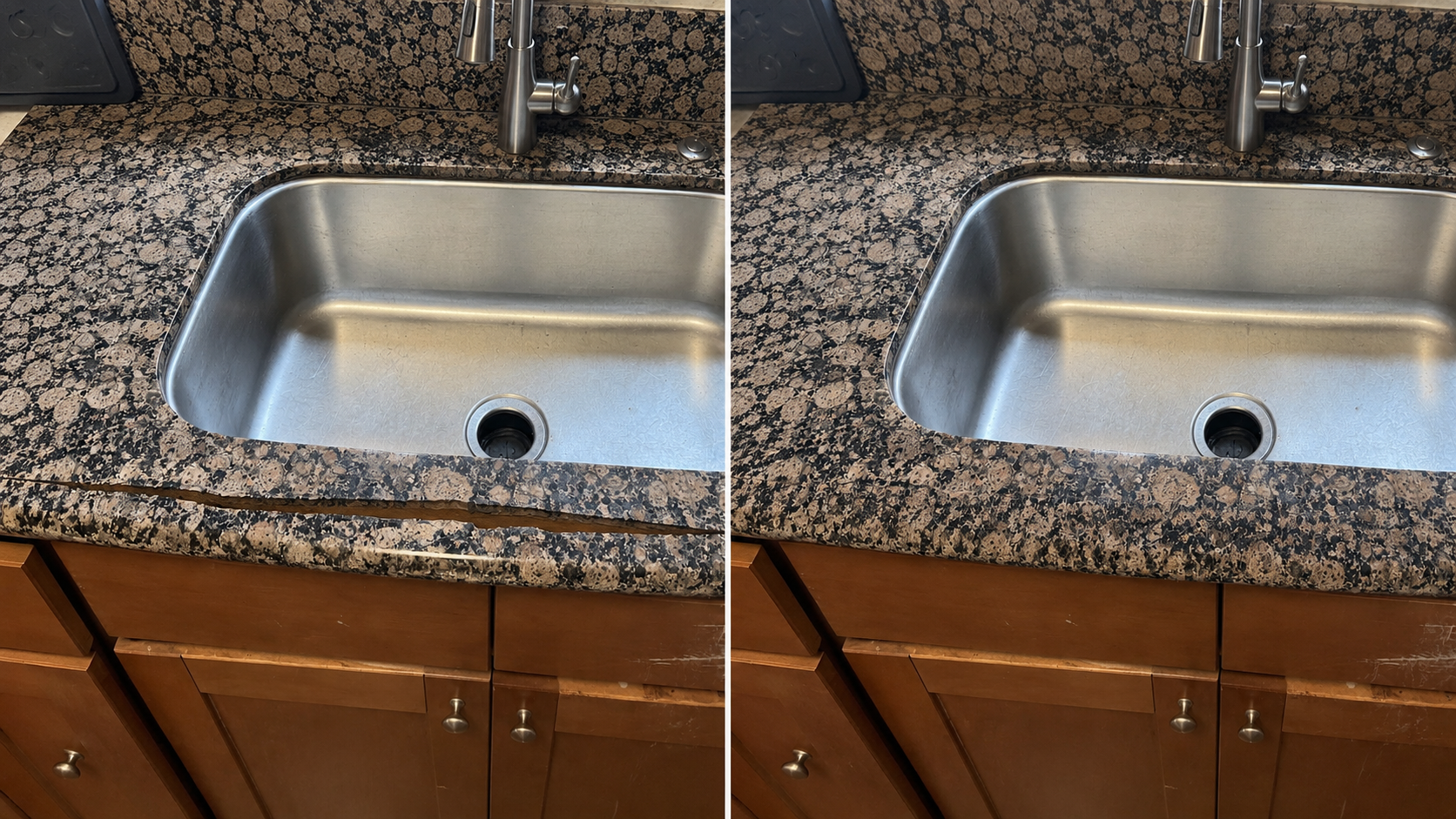
Granite Seam Separation or Structural Crack? How to Tell What’s Happening to Your Countertop
Maybe it has always been there, but suddenly it looks wider.
Perhaps one side sits slightly higher than the other.
The material between the two slabs is beginning to crumble.
Or maybe what you thought was a seam appears to continue into the granite itself.
At that point, most homeowners start asking the same question:
“Is my seam just coming apart, or is the granite actually cracked?”
That distinction matters.
A granite seam that needs fresh adhesive is not the same problem as a countertop that is moving because of poor support.
And neither is exactly the same as a structural fracture running through the stone.
At Sureshine Care and Restoration Services, Inc., we repair granite countertops throughout Coppell and the Dallas–Fort Worth area, and one of the most important parts of any repair is identifying what actually failed before deciding how to fix it.
First: What Is a Granite Countertop Seam?
Most kitchens are too large to fabricate from a single piece of granite.
Even when large slabs are available, transportation, installation access, slab dimensions, cabinetry layouts, sink openings, and stone movement often make seams necessary.
A granite seam is simply the joint where two separate pieces of stone meet.
During installation, the fabricator carefully positions the slabs, levels them as closely as possible, and bonds the joint using appropriate adhesive and color-matched seam material.
A properly executed seam should be:
- Structurally stable
- Relatively level from one side to the other
- Consistent in width
- Visually compatible with the stone
But a seam is still a joint between two separate pieces of natural stone.
Over time, conditions beneath the countertop can change.
Why Do Granite Seams Separate?
There isn’t one universal reason.
A seam may open because of:
- Cabinet movement
- Foundation movement
- Inadequate countertop support
- Failed adhesive
- Improper initial installation
- Heavy stress near the seam
- Movement around sinks or cooktops
- Long unsupported spans
Sometimes the original seam adhesive simply deteriorates.
Other times, the seam failure is only the visible symptom of something happening underneath the granite.
That is why diagnosis matters.
A Seam Can Look Like a Crack
Homeowners frequently use the words crack and seam interchangeably.
That’s understandable.
Both can appear as a line across the countertop.
But there is an important difference.
A seam is an intentional joint created during fabrication and installation.
A crack is a fracture in a piece of stone that was originally continuous.
If you’re unsure which one you’re looking at, clues may include:
- Where the line is located
- Whether it extends all the way through the slab
- Whether the pattern changes on either side
- Whether one side moves independently
- Whether the line is becoming wider over time
A professional inspection is usually the best way to determine exactly what you’re dealing with.
What Does a Failing Seam Look Like?
A seam problem may show one or several signs.
You might notice:
- Filler cracking out of the joint
- The seam becoming wider
- One slab sitting higher than the other
- Dark dirt collecting in the joint
- Movement when pressure is applied
- Adhesive separating from one side
Some of these conditions are primarily cosmetic.
Others indicate movement that should be addressed before the seam is simply refilled.
Why Does One Side of a Granite Seam Sometimes Become Higher?
This is often referred to as a height difference or lippage at the seam.
There can be several causes.
Cabinetry may have shifted.
A support may have compressed or failed.
The granite may not have been installed perfectly level in the first place.
Or movement in the structure beneath the countertop may have changed the position of one slab relative to the other.
If one side is moving, simply applying new seam filler won’t correct the height difference.
The slabs first need to be stabilized and aligned as appropriately as possible.
Why Sink Areas Are Especially Important
Seam problems near sinks deserve extra attention because sink cutouts already create weaker areas in the countertop.
The granite around the sink is narrower than the rest of the slab.
It may also experience:
- Moisture exposure
- Garbage disposal vibration
- Sink weight
- Daily leaning and pressure
- Cabinet movement
- Stress around faucet holes
If a seam is located near one of these areas, movement may involve more than deteriorated seam material.
That doesn’t automatically mean the countertop is structurally failing, but it does justify a closer look.
What Is a Structural Granite Crack?
A structural crack is a true fracture through the stone.
The granite that was once one continuous piece has separated.
This can happen because of:
- Movement
- Impact
- Inadequate support
- Stress around cutouts
- Rusted reinforcement
- Previous failed repairs
A structural crack may appear near a seam, which can make the condition confusing.
In some situations, the original seam may remain intact while the granite next to it fractures.
In others, both the seam and adjacent stone may be involved.
Can a Seam Failure Turn Into a Structural Problem?
Potentially, yes.
If the seam is opening because the slabs are moving, continued movement can place stress on nearby stone.
Natural stone performs best when it is evenly supported.
If one slab begins carrying loads differently than the other, stress can become concentrated near the joint.
That doesn’t mean every open seam will create a crack.
It does mean an actively moving seam should not simply be treated as a cosmetic line.
Why Simply Adding New Filler May Not Work
This is one of the most common repair mistakes.
The old seam material begins breaking out.
Someone cleans the top of the joint.
Fresh filler is added.
The seam looks better for a while.
Then it opens again.
Why?
Because if the slabs are still moving, the filler is being asked to hold two pieces of stone in positions they no longer want to maintain.
The repair material isn’t the real problem.
The movement is.
A durable repair starts by addressing stability.
How Sureshine Evaluates Granite Seam Problems
During an evaluation, we look at more than the visible joint.
We may evaluate:
- Seam width
- Height difference
- Movement
- Cabinet support
- Nearby cutouts
- Condition of existing adhesive
- Moisture exposure
- Adjacent fractures
- Previous repairs
The goal is to determine whether the project requires:
- Cosmetic seam repair
- Re-leveling
- Structural stabilization
- Crack repair
- A combination of services
What Does a Professional Granite Seam Repair Involve?
The exact process depends on the condition of the countertop.
A straightforward seam repair may involve removing deteriorated material, properly cleaning and preparing the joint, aligning the slabs, installing appropriate adhesive, color matching, and refining the finished surface.
When movement or height differences are involved, the process becomes more comprehensive.
The countertop may need to be stabilized, carefully repositioned, leveled, and supported before the seam can be properly rebonded.
The repair should solve the problem rather than simply hide the symptom.
What If the Granite Is Cracked Right Next to the Seam?
Then we treat the conditions separately.
The seam may need repair.
The crack may need structural restoration.
Trying to treat both issues as the same thing can lead to disappointing results.
Sureshine’s Granite Crack Repair System is designed to restore structural integrity when the granite itself has fractured.
Depending on the failure, that may involve exposing the damaged area, addressing failed reinforcement if present, structurally bonding the stone, leveling the repair, grinding, polishing, and sealing.
Can Granite Seams Be Made Invisible?
We don’t promise invisible seams.
A seam is still the meeting point between two separate pieces of granite.
Some stones disguise seams extremely well because they contain movement, crystals, veins, and color variation.
Other granites are much more uniform, which can make the joint easier to see.
Lighting also affects visibility.
A seam may be difficult to notice from normal standing height and more visible when viewed closely under directional light.
Our goal is a professional, stable, well-blended repair—not an unrealistic claim that the seam has somehow stopped existing.
Can a Raised Seam Be Leveled?
In many cases, the appearance and feel of a raised seam can be improved.
The appropriate approach depends on how much height difference exists and why it developed.
If the slabs can be repositioned, correcting the support and alignment may resolve much of the problem.
In other situations, controlled mechanical refinement may be needed to improve the transition.
The exact technique should be determined after evaluating the stone and structure.
Why Granite Pattern Matters During Seam Repair
Granite is not a manufactured sheet with a perfectly repeated pattern.
Every slab contains its own movement.
That means a repaired seam has to work visually with:
- Background color
- Mineral crystals
- Veins
- Speckling
- Pattern direction
Color matching seam adhesive is part chemistry and part visual judgment.
The objective is to make the repair compatible with the surrounding stone rather than creating a line that draws attention to itself.
What About Old Seam Repairs?
Older repairs can complicate the project.
Previous seam materials may include different adhesives, fillers, dyes, or surface coatings.
If those materials are loose, discolored, or incompatible with the new repair, they may need to be removed before a reliable bond can be established.
This is another reason repeated layers of DIY filler can eventually make professional repair more difficult.
Should You Try a DIY Granite Seam Repair?
For a purely cosmetic gap with no movement, some homeowners may be tempted to try a repair kit.
The risk is assuming the issue is cosmetic when it isn’t.
If one slab moves, sits higher, or has separated because of support problems, adding adhesive from the top may not solve anything.
And if the repair material cures deep inside the joint in the wrong position, it may have to be removed later before the slabs can be properly aligned.
If the seam is moving or significantly uneven, professional evaluation is the safer approach.
Is the Countertop Still Safe to Use?
Many seam problems do not create an immediate safety emergency.
But active movement should not be ignored.
If the granite is loose, rocking, heavily separated, or fractured, avoid putting unnecessary weight on the affected area until it can be evaluated.
Heavy appliances, people leaning against the counter, or other concentrated loads can increase stress on an already compromised installation.
What Causes Granite Seams to Fail Years After Installation?
A seam may perform perfectly for many years before a problem appears.
That can happen because houses move.
Cabinets settle.
Adhesives age.
Moisture conditions change.
Supports loosen.
Daily use adds thousands of small stress cycles over time.
The fact that a countertop performed well for fifteen years does not mean conditions beneath it have remained exactly the same.
Can Foundation Movement Affect Granite Countertops?
Potentially.
Granite is rigid.
If the structure supporting it changes enough, stress may be transferred into the stone or seams.
That does not mean every countertop crack indicates a foundation problem.
Far more localized causes are common.
But if multiple parts of the home show movement, the countertop may be responding to a broader structural condition.
Countertop repair should not be used as a substitute for correcting an active building problem.
What If the Seam Is Near a Dishwasher?
Dishwasher locations can introduce additional variables.
Heat, moisture, cabinet configuration, and support can all affect the surrounding countertop environment.
If a seam near a dishwasher is moving, we want to understand how the stone is supported in that area rather than simply assuming the adhesive failed.
What If the Seam Is Near a Cooktop?
Cooktop openings create another interruption in the granite slab.
The remaining strips of stone around the opening may be relatively narrow.
If a seam is also located nearby, careful evaluation is especially important because several stress points may exist in the same area.
Again, the visible seam may not tell the entire story.
Granite Seam Repair vs. Granite Crack Repair
These services overlap, but they’re not identical.
Seam repair addresses the joint between separate slabs.
Crack repair addresses fractured stone.
A project can involve one or both.
That’s why accurately diagnosing the failure is more important than simply deciding that every visible line needs epoxy.
Can a Granite Seam Be Repaired Without Replacing the Countertop?
Very often, yes.
Seam problems are generally repair issues—not automatic replacement issues.
Preserving the original countertop also avoids many complications associated with replacement, including:
- Demolition
- Risk to cabinetry
- Backsplash damage
- Plumbing work
- Finding matching stone
- Fabrication
- Installation downtime
If the granite itself is still serviceable, professional repair can often extend its life significantly.
Why Matching Older Granite Can Be Difficult
Natural stone comes from the earth.
A slab installed fifteen years ago may have come from a quarry section that no longer exists.
Even slabs sold under the same trade name today may have different:
- Colors
- Crystal sizes
- Veining
- Movement
That can make replacing only one section of a granite countertop extremely difficult without creating an obvious mismatch.
Repair preserves the material already coordinated throughout the kitchen.
What Happens After the Seam Is Repaired?
The repaired area is refined to make the transition as natural as reasonably possible.
If the surrounding granite has broader finish issues, additional granite polishing and sealing may also be worth considering.
The specific recommendation depends on the condition of the rest of the countertop.
We don’t believe in adding services simply because we’re already there.
The stone should receive what it actually needs.
What If the Problem Is Really a Structural Crack?
If the granite itself has fractured, Sureshine’s structural repair approach focuses on preserving and rebuilding the existing countertop whenever practical.
For qualifying granite crack repairs, Sureshine provides a Lifetime Structural Warranty.
Our objective is that the repaired structural area will not come apart again under normal conditions.
The warranty excludes new client-caused damage or other outside forces, and cosmetic maintenance may occasionally be appropriate over the life of a natural stone repair.
The important point is that structural repair is intended to restore strength—not merely hide the visible crack.
Granite Seam and Crack Repair in Coppell, Texas
Granite countertops are built to last, but the kitchens around them can change over time.
Cabinetry settles.
Homes move.
Seam materials age.
Support conditions change.
If you’re seeing separation, unevenness, movement, or cracking, don’t assume replacement is the next step.
The first step should be determining what failed.
Is it the seam?
The support?
The granite?
Or a combination of all three?
Once the cause is understood, the repair can be designed around the actual problem.
Have a Granite Seam That Is Opening or Uneven?
Sureshine Care and Restoration Services, Inc. provides professional granite seam repair, granite crack repair, polishing, and restoration throughout Coppell and the Dallas–Fort Worth area.
We’ll evaluate the countertop, explain whether the issue appears cosmetic or structural, and discuss the realistic repair options before recommending a scope of work.
Dallas–Fort Worth: (972) 734-8933
Schedule an Estimate: Book a Granite Countertop Evaluation
You can also learn more about professional granite countertop repairs and Sureshine Granite Crack Repair.
Frequently Asked Questions About Granite Seam Separation and Cracks
How can I tell if the line in my granite is a seam or a crack?
A seam is an intentional joint where two separate granite slabs were installed next to one another. A crack is an unplanned fracture through stone that was originally continuous. Seams are often located in predictable fabrication areas and may contain adhesive or filler. If the line appeared suddenly, continues through a single slab, shows movement, or doesn’t correspond to an installation joint, it may be a crack. A professional evaluation can confirm the difference.
Why did my granite seam start opening after years with no problem?
Several conditions may contribute. Seam adhesive can deteriorate, cabinetry can settle, supports may change, or movement in the home can alter the relative position of the slabs. Sometimes the seam material itself is the primary problem. Other times the failed seam is simply evidence of movement beneath the countertop. Understanding which condition exists is important before installing new seam material.
Can you repair a granite seam that is higher on one side?
Often, the condition can be significantly improved, but the cause of the height difference has to be understood first. If the slabs are moving or inadequately supported, they may need to be stabilized and repositioned before the seam is rebonded. Depending on the stone and amount of height difference, additional mechanical refinement may be appropriate to improve the transition between the two sides.
Will the repaired granite seam be invisible?
We don’t promise invisible seams. Granite is natural stone, and seam visibility depends on the pattern, color, mineral movement, lighting, width of the joint, and alignment of the slabs. The goal is a stable, properly aligned, professionally color-matched seam that blends well with the surrounding countertop. Some stones hide seams extremely well, while very uniform materials can make them easier to see.
Can I just fill an opening granite seam with epoxy?
If the seam is stable and the only problem is deteriorated filler, a relatively straightforward seam repair may be appropriate. If the slabs are moving, uneven, or poorly supported, simply placing epoxy into the visible gap may not address the underlying cause. The movement can cause the repair to fail again. Structural stability should be evaluated before treating an actively opening seam as a cosmetic problem.
Is a separated seam dangerous?
Not every seam separation presents an immediate hazard. However, significant movement, loose stone, severe height differences, or fractures adjacent to the seam should not be ignored. Avoid placing unnecessary heavy loads on an obviously unstable area until it has been evaluated. The severity depends on the location, support, amount of movement, and condition of the granite.
Can a granite crack happen right next to a seam?
Yes. A seam is already a transition between two slabs, and if movement or stress is occurring in that area, the adjacent granite may also fracture. In that situation, the seam and the structural crack need to be evaluated separately. Repairing only the joint may leave the fractured stone untreated.
Does an open granite seam mean my foundation is moving?
Not necessarily. Foundation movement is one possible source of structural movement, but there are many more localized explanations, including cabinet settling, inadequate support, aging adhesive, installation conditions, or stress near sink and cooktop openings. A countertop seam by itself is not enough to diagnose a foundation problem.
Can old granite seams be repaired without replacing the counters?
Very often, yes. Most seam failures are repair issues rather than reasons to replace an entire countertop. Repair also has the advantage of preserving the original granite, which may be difficult or impossible to match if the material was installed many years ago.
What is the difference between granite seam repair and granite crack repair?
Granite seam repair restores the intentional joint between two separate countertop pieces. Granite crack repair restores stone that has fractured within a slab or narrow structural area. The processes may overlap when movement affects both the seam and surrounding stone, but the underlying conditions are different. A proper repair starts by identifying which components actually failed.
Should I repair the seam before having the granite polished?
Generally, structural or seam repairs should be evaluated and addressed as part of the overall restoration plan before final polishing is completed. That allows the repaired areas to be leveled, blended, and refined with the surrounding countertop as appropriate. The exact sequence depends on the condition of the granite and the scope of work.
How can I prevent a granite seam from separating again?
The most important factor is correcting any underlying cause rather than focusing only on the seam filler. Proper support, stable cabinetry, appropriate alignment, and professional adhesive all contribute to long-term performance. Avoid placing excessive concentrated weight near vulnerable countertop sections, and have new movement or cracking evaluated before it progresses.