Rust Near a Granite Sink Crack? Why It May Be a Warning Sign
Then you see something else.
A brown or orange discoloration appears along the crack.
Maybe the granite feels slightly raised.
Perhaps the crack seems wider than it did a few months ago.
Or you notice movement when you press lightly on the narrow strip of stone around the sink.
Those details matter.
Rust appearing near a granite sink crack may be more than a surface stain. In some countertops, it can be evidence that steel reinforcement inside or beneath the granite is corroding.
And when steel corrodes, it expands.
That expansion can place enough pressure on the surrounding stone to contribute to a structural crack.
At Sureshine Care and Restoration Services, Inc., we specialize in granite crack repair throughout Palos Verdes Estates, Los Angeles County, Orange County, and surrounding Southern California communities.
One of the most important things homeowners should understand is that a crack near the sink may be a symptom of something happening below the visible surface.
Why Are Granite Countertops Reinforced Around Sinks?
A granite slab can be strong across a large uninterrupted surface.
But when a sink opening is cut into the slab, much of that stone is removed.
This leaves relatively narrow strips of granite in front of and behind the sink.
These narrow areas are often referred to as sink rails.
Sink rails can be more vulnerable during fabrication, transport, installation, and years of daily use.
To increase strength, some fabricators historically cut channels into the underside of the granite and installed steel reinforcing rods.
This process is commonly called rodding.
The concept was simple:
Use steel to reinforce a thin section of stone.
The long-term problem is that ordinary steel can rust.
How Does Rust Crack Granite?
Rust is not simply discoloration sitting on the surface of metal.
When iron and steel corrode, the corrosion products take up more volume than the original metal.
In other words, the steel expands as it rusts.
Now imagine that process happening inside a narrow channel cut into the underside of a granite sink rail.
The expanding corrosion presses outward against the surrounding stone.
Granite is very hard, but hard does not mean flexible.
If enough internal pressure develops, the stone may fracture.
That is why some granite sink cracks seem to appear even though nobody dropped anything heavy on the countertop.
The damaging force may be developing inside the granite itself.
Where Does the Water Come From?
For steel to rust, moisture must reach it.
Kitchen sinks provide several potential pathways.
Over time, moisture may enter from:
- Failed sink caulking
- Water around the faucet
- Repeated splashing
- Plumbing leaks
- Dishwasher or disposal-related moisture
- Water entering cracks or seams
One small gap in sink caulking may not seem important.
But repeated moisture exposure over many years can create conditions that allow hidden steel reinforcement to corrode.
This is why maintaining sink caulking is more important than many homeowners realize.
What Does Rust Near a Granite Crack Look Like?
Several visual clues may suggest corrosion is involved.
You may notice:
- Orange or brown discoloration
- Rust-colored staining along a crack
- A dark line that becomes reddish or brown
- Swelling or lifting near the crack
- A narrow strip of granite separating from the countertop
- Multiple cracks developing in the same sink rail
None of these signs alone proves that a rusted rod is present.
Granite can contain natural iron-bearing minerals, and rust staining can come from other sources.
But when rust discoloration appears together with movement or a structural sink-rail crack, reinforcement corrosion should be considered.
Can Granite Itself Rust?
Granite does not “rust” in the same way steel does.
However, some natural stones contain iron-bearing minerals that may oxidize and produce discoloration under certain conditions.
Rust can also come from external metal objects, plumbing components, fasteners, or steel reinforcement associated with the countertop.
That is why the source of the discoloration needs to be identified before deciding how to treat it.
Removing a rust-colored stain from the surface does not necessarily solve a structural reinforcement problem underneath.
Why Front Sink Rails Crack So Often
The narrow strip of granite in front of the sink is one of the most common locations for structural countertop failures.
It receives daily stress from:
- People leaning against the counter
- Heavy pots and pans
- Movement around the sink
- Cabinet settlement
- Sink weight
- Garbage disposal vibration
If rusting reinforcement is also pushing outward from inside the stone, several forms of stress can be acting on the same narrow section simultaneously.
Eventually, the granite may separate.
Cracks Behind the Sink Can Be Just as Serious
Rear sink rails are easy to overlook because they’re harder to see.
Faucets, soap dispensers, backsplashes, and other fixtures may hide part of the damage.
The crack may develop around a faucet hole or run through the narrow strip between the sink and backsplash.
Access can also make rear sink-rail repairs more complicated.
Depending on the configuration, faucets or fixtures may need to be removed so the damaged area can be properly accessed, prepared, stabilized, and refinished.
Why Simply Filling the Crack Isn’t Always a Repair
Imagine a rusted steel rod continuing to expand inside the granite.
If someone simply injects adhesive into the visible crack and smooths the top, what happened to the rod?
Nothing.
The force that caused the crack may still be present.
The same principle applies if the countertop is moving because of failed support.
A cosmetic filler may improve the appearance temporarily, but it does not automatically correct the structural condition.
This is why Sureshine approaches granite crack repair as a structural restoration rather than just a surface touch-up.
The First Step Is Determining Why the Granite Failed
Before repairing the crack, we want to understand what caused it.
During an evaluation, we may look at:
- Crack location
- Crack direction
- Movement between sections
- Height differences
- Rust staining
- Sink caulking
- Faucet and fixture locations
- Countertop support
- Previous repairs
- Condition of the cabinetry
The visible crack is only one piece of the diagnosis.
The Sureshine Granite Crack Repair System
Every repair is different, but the Sureshine Granite Crack Repair System is designed around one basic principle:
Correct the structural failure rather than simply hiding the crack.
Depending on the condition, a repair may involve several stages.
1. Expose the Damaged Area
We need access to the fractured granite and any failed reinforcement contributing to the problem.
That may require carefully opening the repair area and removing deteriorated material.
On some rear sink-rail repairs, fixture removal may also be necessary to gain proper access.
2. Address Rusted Reinforcement
If corroded reinforcement is contributing to the failure, simply leaving all of the rusted material in place would not address the problem.
Where appropriate and accessible, Sureshine exposes and removes the rusted portion of the rod—as much as practical for the specific repair.
This wording matters.
We do not claim that every piece of reinforcement throughout the entire countertop can or should be removed.
The repair is focused on the damaged area and the material contributing to the failure.
3. Prepare the Broken Granite
Successful structural bonding requires clean, sound material.
Loose debris, deteriorated adhesive, corrosion products, contamination, and failed repair material may need to be removed before the countertop can be rebuilt.
4. Reassemble the Sink Rail
The broken granite is repositioned and structurally bonded using professional adhesives appropriate for the repair.
Depending on the fracture, the sink rail may need:
- Clamping
- Bracing
- Alignment
- Reinforcement
- Leveling
Some severe sink-rail failures involve several broken pieces rather than one simple crack.
Those repairs become more like reconstruction than filling.
5. Level the Repaired Area
A structural repair should not leave one section noticeably higher than another if the condition can be corrected.
Once the pieces are stable, the transition is carefully refined so the countertop functions properly and feels appropriate under normal use.
6. Blend the Repair
Repair materials are color matched and blended with the surrounding stone.
Granite can contain:
- Multiple colors
- Crystals
- Mineral movement
- Veins
- Speckles
Those characteristics can help disguise a repair.
Very uniform granite may make the repaired line easier to see.
We believe in realistic expectations.
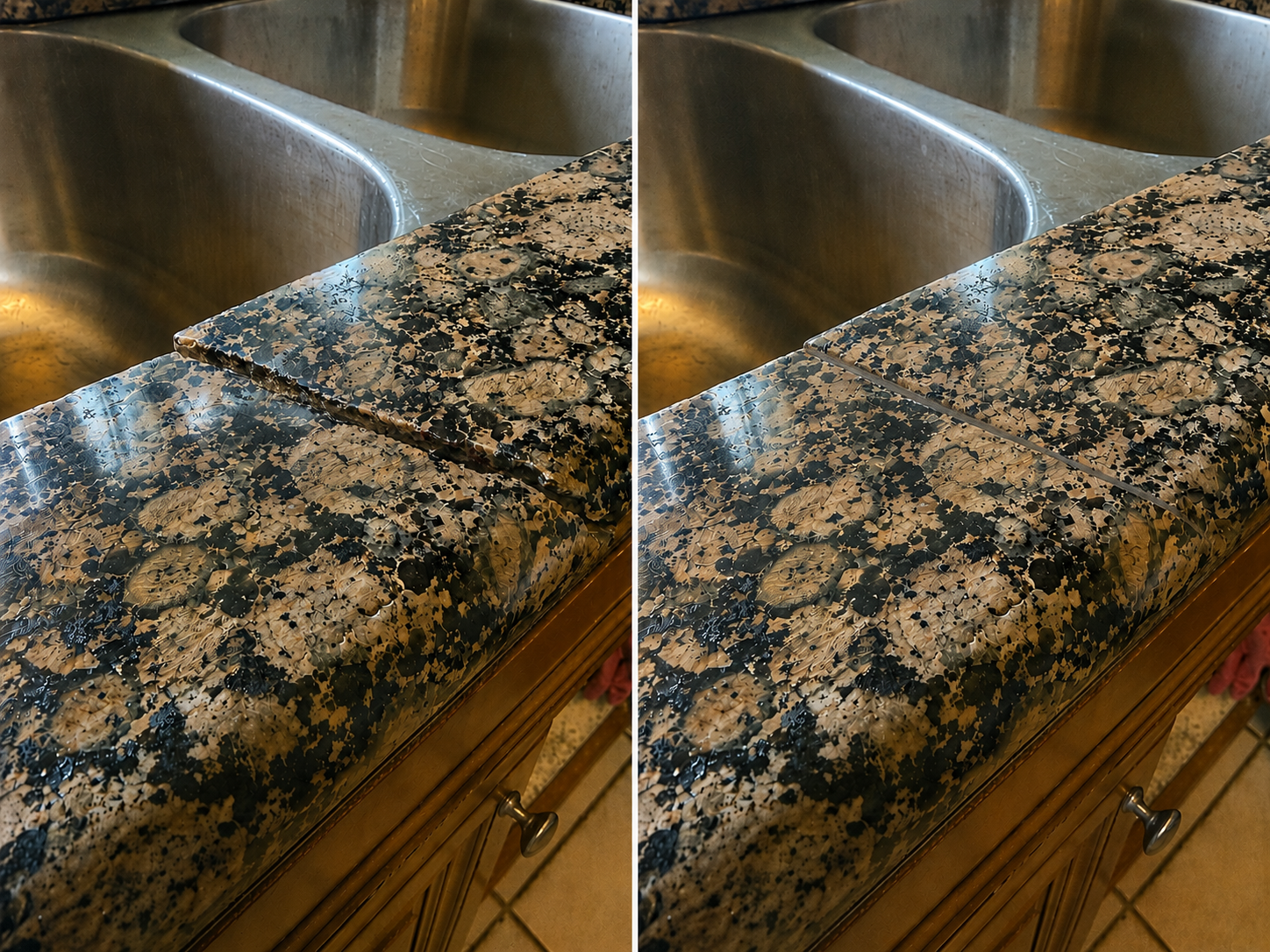
The repaired area may retain a thin visible seam.
Our goal is not to promise an impossible “flawless” or “invisible” repair.
Our goal is a strong, professional repair that looks appropriate within the natural pattern of the stone.
7. Grind and Polish the Granite
After the structural work is completed, grinding and polishing may be used to refine the repaired area and restore the surrounding finish.
Granite polishing requires specialized mechanical methods designed for the specific stone.
If the rest of the countertop has become dull or worn, broader granite polishing and sealing can also be considered.
8. Seal and Restore the Sink Area
Once the stone work is complete, the sink area needs to be properly restored.
This includes maintaining or replacing deteriorated caulking where appropriate.
Keeping sink caulking in good condition helps reduce future water intrusion into vulnerable areas beneath the countertop.
Can a Badly Cracked Granite Sink Rail Really Be Saved?
Often, yes.
We’ve seen countertops where the front sink rail was separated into several pieces and initially looked beyond repair.
But the visual severity of a failure does not automatically tell us whether the countertop can be reconstructed.
The real questions are:
Is enough sound granite still present?
Can the damaging condition be addressed?
Can the pieces be structurally reassembled?
Can the repair area be stabilized?
If those answers are favorable, repair may preserve the countertop without replacing it.
Why Replacement Can Become a Much Bigger Project
Replacing granite is rarely limited to removing one slab and dropping in another.
It can involve:
- Countertop demolition
- Plumbing disconnection
- Sink removal
- Backsplash disruption
- Risk to cabinetry
- New slab selection
- Fabrication
- Installation
- Matching existing stone
Older granite can be particularly difficult to match.
Even stone sold under the same trade name may come from a different section of the quarry and have noticeably different color, crystal size, or movement.
Repair allows homeowners to preserve the stone already coordinated with the rest of the kitchen.
Is Rust Near the Crack an Emergency?
Not every rust-colored mark means the countertop is about to collapse.
But rust combined with movement, swelling, widening cracks, or sink-rail separation should not be ignored.
Continued corrosion can worsen over time.
Continued water exposure can contribute to additional deterioration.
And continued movement can allow the crack to grow.
Early evaluation usually gives you more repair options than waiting until the sink rail has broken into multiple sections.
Should You Stop Using the Sink?
That depends on the severity of the damage.
A stable hairline crack does not necessarily mean normal sink use must stop immediately.
But if the granite:
- Moves when touched
- Has separated significantly
- Has loose pieces
- Is supporting a loose sink
- Shows major displacement
then reducing unnecessary stress until the area is evaluated is sensible.
Avoid leaning heavily on the affected sink rail or placing excessive loads on unstable sections.
What If Someone Already Tried to Repair It?
Previous repairs are common.
Sometimes a homeowner or contractor filled the crack with epoxy, superglue, polyester resin, or another material.
That may improve appearance temporarily.
But if corrosion or movement continued underneath, the crack may reopen.
Old repair material can also make the structural repair more complicated because it may need to be removed before a reliable bond can be established.
A failed previous repair does not automatically mean the countertop cannot be saved.
It simply needs to be evaluated as part of the overall condition.
What If the Rust Is Only on the Surface?
Not every rust stain indicates structural damage.
Metal objects can leave rust on granite.
Examples include:
- Soap dispensers
- Metal containers
- Decorative objects
- Appliance feet
- Tools
If there is no crack, swelling, or movement, the problem may primarily be staining rather than a structural failure.
Rust stains can sometimes be treated with specialized stone-stain methods.
The key is identifying the source before assuming the countertop needs structural repair.
Why Sink Caulking Is So Important
This may be the least glamorous part of granite maintenance, but it is one of the most important.
Caulking around a sink does not last forever.
It can:
- Shrink
- Separate
- Crack
- Pull away
- Develop small gaps
When those gaps appear, water can begin entering the countertop assembly.
Homeowners should inspect sink caulking periodically and have it renewed when necessary.
This is particularly important after a structural granite repair.
Sureshine’s Lifetime Structural Warranty
Sureshine stands behind qualifying Granite Crack Repair System repairs with a Lifetime Structural Warranty.
The goal is simple:
The repaired structural area will not come apart again under normal conditions.
The warranty does not cover new client-caused damage, outside forces, or unrelated future damage elsewhere in the countertop.
Natural stone repairs may also occasionally require aesthetic touch-ups over time.
The warranty is focused on the structural integrity of the repaired failure.
Can a Repaired Granite Crack Still Be Visible?
Yes.
And we think homeowners should know that before the work begins.
Some granite patterns make repairs extremely difficult to notice.
Others make every line visible.
Factors include:
- Stone color
- Mineral pattern
- Lighting
- Crack width
- Amount of displacement
- Number of broken pieces
A thin resin seam may remain where the crack once existed.
That is very different from a failed, moving structural fracture.
The objective is to restore the countertop structurally and improve the appearance as much as the stone allows.
Can the Whole Kitchen Be Polished After the Repair?
Yes, if the rest of the granite would benefit from polishing.
A crack repair and a full countertop polish are separate services, but they can complement each other.
If the granite has hard-water buildup, dull areas, fine scratches, residue, or an inconsistent finish, professional polishing may improve the overall appearance after the structural repair is complete.
Sureshine also offers a 50% discount on a qualifying full-kitchen granite polish and seal when performed with a Granite Crack Repair project.
Granite Crack Repair in Palos Verdes Estates
Many Palos Verdes Estates homes have granite kitchens that have been in service for years or even decades.
As those countertops age, sink caulking, reinforcement, support systems, adhesives, and surrounding cabinetry can change.
A granite countertop does not automatically need replacement because a sink rail has failed.
And rust around a crack does not automatically mean the entire slab is ruined.
It means the problem should be evaluated properly.
The goal is to identify whether corrosion, movement, support, impact, or another condition caused the failure—and then repair the actual problem rather than simply covering the visible line.
Seeing Rust or a Crack Near Your Granite Sink?
If you’ve noticed rust-colored staining, swelling, movement, or a crack around your granite sink, Sureshine can evaluate the countertop and explain what may be happening beneath the surface.
Sureshine Care and Restoration Services, Inc. specializes in difficult structural granite crack repairs, including front and rear sink-rail failures, rusted reinforcement, multiple broken sections, and previous unsuccessful repairs.
Our goal is to preserve the original granite whenever practical and restore structural integrity without unnecessary countertop replacement.
Call Sureshine’s Los Angeles team: (310) 971-9997
Schedule an Estimate: Request a Granite Crack Repair Evaluation
Learn more about the Sureshine Granite Crack Repair System and our other granite countertop repair services.
Frequently Asked Questions About Rust and Granite Sink Cracks
Does rust near my granite sink crack mean there is a metal rod inside the countertop?
It is possible, but the discoloration alone is not enough to confirm it. Some granite sink rails were reinforced with steel rods during fabrication, and those rods can corrode if moisture reaches them. However, rust staining can also come from external metal or iron-bearing minerals. When rust appears together with a structural crack, swelling, or movement, reinforcement corrosion becomes a more important possibility to investigate.
Why does rust make granite crack?
Corroding steel expands. If that expansion occurs inside a channel cut into a narrow granite sink rail, the corrosion can create pressure against the surrounding stone. Granite is hard but brittle, so sufficient internal pressure can contribute to fracture. This is why removing or addressing the affected rusted reinforcement can be an important part of a structural repair.
Do you remove the entire reinforcement rod?
Not necessarily. Sureshine exposes and removes the rusted portion of the rod—as much as practical and appropriate for the individual repair. We avoid blanket claims that every inch of reinforcing material can or should be removed because access, fabrication methods, and countertop configurations vary considerably.
Can you just remove the rust stain without repairing the crack?
If the rust is a surface stain from an external metal object and the granite itself is structurally sound, specialized stain treatment may be appropriate. If the rust is related to corroded reinforcement inside a cracked sink rail, treating only the surface discoloration would not address the structural failure or the source of the corrosion.
Will a repaired granite sink crack completely disappear?
Not always. The visual result depends on the granite’s color, pattern, crystals, movement, severity of the fracture, and lighting. The repair is color blended and polished as appropriately as possible, but a thin resin seam may remain visible. Sureshine’s priority is structural integrity followed by the best realistic cosmetic improvement the stone allows.
Can a granite sink rail that has completely separated be repaired?
Many severe sink-rail failures can be reconstructed. The broken sections may need to be cleaned, repositioned, structurally bonded, clamped, stabilized, leveled, blended, and polished. The feasibility depends on how much sound stone remains, what caused the failure, and whether the underlying condition can be addressed.
Why did my granite crack years after installation?
Some countertop failures develop gradually. Steel reinforcement may corrode slowly. Sink caulking may deteriorate. Cabinets or supports may shift. Repeated daily stress can accumulate. A granite countertop can perform normally for many years before one of these conditions becomes severe enough for a visible crack to appear.
Does a crack near the sink mean the sink could fall?
Not necessarily, but the support and mounting of the sink should be evaluated if the surrounding granite is significantly damaged or moving. A loose sink, separated rail, or unstable countertop section deserves prompt attention because several parts of the installation may be interacting with one another.
Can I keep using the countertop while waiting for repair?
If the crack is stable and there is no significant movement, normal cautious use may be possible. If the stone is loose, displaced, moving, or badly fractured, avoid applying unnecessary pressure or heavy loads to the area until it has been evaluated. Significant structural failures should not be treated as purely cosmetic issues.
How do I help prevent moisture from reaching reinforcement in the future?
Maintain the caulking around the sink and fixtures. If you notice gaps, separation, or missing caulk, have it corrected. Keep an eye on plumbing leaks and water that routinely collects around the sink. Preventing repeated moisture intrusion is one of the simplest ways to protect the countertop assembly over time.
Is repairing the granite better than replacing it?
When the existing stone can be structurally restored, repair often avoids the demolition, plumbing work, fabrication costs, backsplash disruption, and matching problems associated with replacement. Older granite can be especially difficult to match because natural stone varies from slab to slab and quarry production changes over time. The best choice depends on the extent of the damage and overall condition of the countertop.
What does Sureshine’s Lifetime Structural Warranty cover?
Qualifying Granite Crack Repair System repairs include a Lifetime Structural Warranty covering the repaired structural area under normal conditions. The repaired area is intended not to come apart again. The warranty does not cover new damage caused by outside forces, client-caused damage, or unrelated failures elsewhere in the countertop. Aesthetic maintenance or touch-ups may occasionally be appropriate over the life of the repair.