Granite Crack in Front of the Sink? Why the Front Sink Rail Fails
At first, you think it’s a scratch.
You wipe it with a towel, but the line doesn’t disappear.
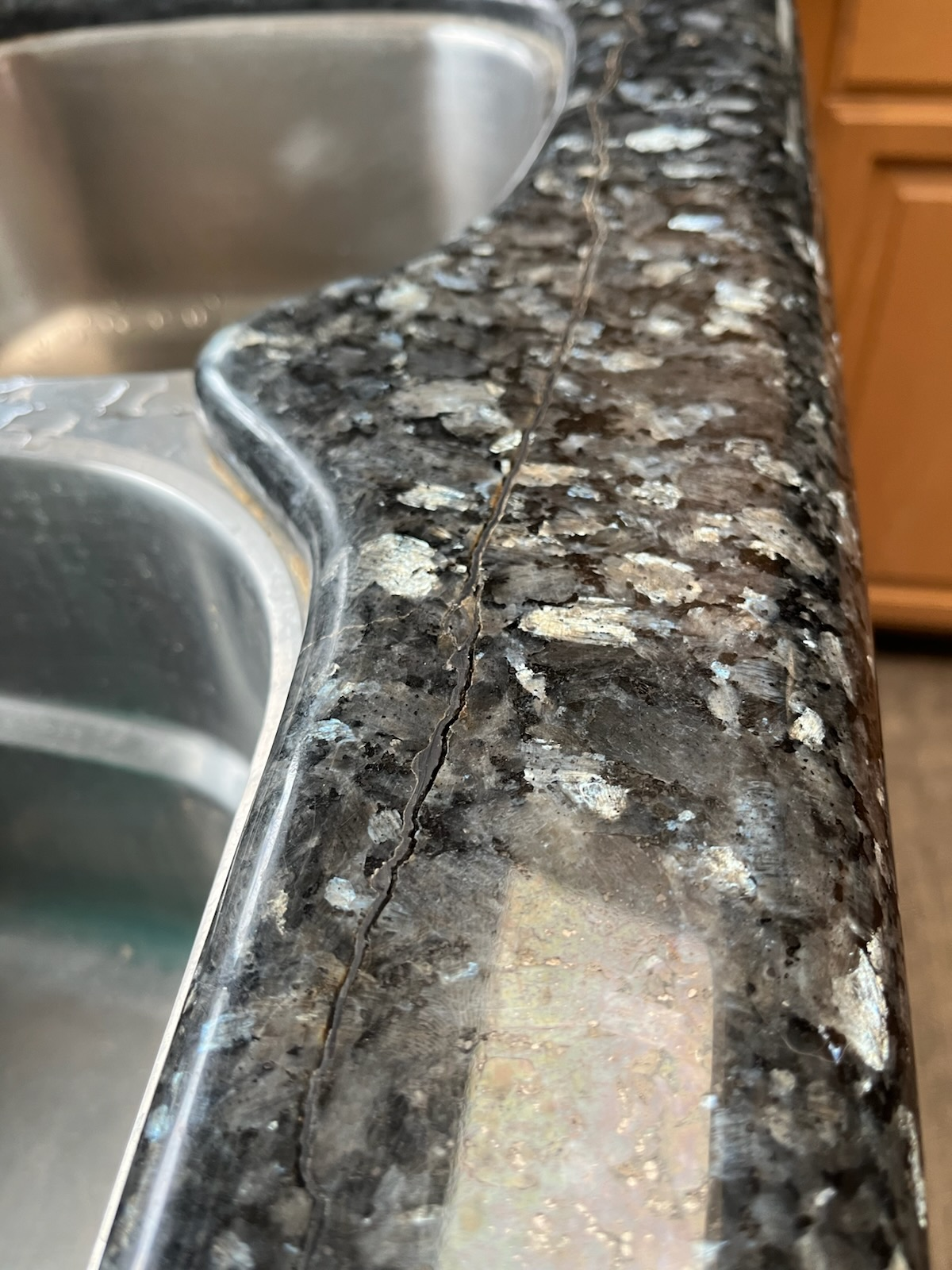
Looking closer, you realize the granite is cracked.
Maybe the crack runs from the sink opening toward the front edge of the countertop. Maybe it follows a line across the narrow strip of granite directly in front of the sink. In some cases, one side of the crack has even started to lift.
Now you’re wondering whether the entire countertop needs to be replaced.
Fortunately, a crack in the front sink rail doesn’t automatically mean your granite countertop is ruined.
At Sureshine Care and Restoration Services, Inc., we’ve been repairing granite countertops since 2006. Over the years, we’ve encountered thousands of granite cracks, including failures in the narrow sections surrounding kitchen sinks.
One of the most common locations is the front sink rail.
Understanding why this area fails is the first step toward repairing it correctly.
What Is the Front Sink Rail of a Granite Countertop?
The front sink rail is the narrow section of granite between the kitchen sink opening and the front edge of the countertop.
When a granite countertop is fabricated, a large opening is cut into the slab to accommodate the sink.
That opening removes a substantial amount of stone.
What’s left around the sink is much narrower than the surrounding countertop.
The front rail is particularly vulnerable because it must span the width of the sink opening while maintaining enough strength to withstand everyday use.
Think about the difference between a full granite slab and a narrow strip of granite.
A full slab has considerable mass and distributes loads across a larger area.
A narrow strip has much less material available to resist bending and movement.
That’s why sink openings are among the most vulnerable areas of a granite countertop.
Why Does Granite Crack in Front of the Sink?
There isn’t just one reason.
A front sink rail can crack because of:
- Corroded steel reinforcement
- Insufficient support
- Stress during fabrication or installation
- Movement in the cabinetry
- Excessive pressure on the narrow rail
- Previous damage
- Impact
- A combination of several conditions
One of the most significant causes we’ve encountered in older granite countertops is rusting steel reinforcement.
And that’s where the problem becomes more complicated than a simple crack in the stone.
Why Was Steel Installed Inside Granite Countertops?
For many years, some granite fabricators installed steel reinforcing rods in narrow sections of countertops.
This practice is commonly called rodding.
The idea was straightforward.
Because the granite around a sink opening is relatively narrow, a reinforcing rod could help support the stone during fabrication, transportation, and installation.
A channel was cut into the underside of the granite.
A steel rod was installed in that channel and secured with adhesive.
When properly installed and protected from moisture, the reinforcement could serve its intended purpose.
Unfortunately, steel and water don’t always get along.
What Happens When the Steel Rod Starts Rusting?
When moisture reaches unprotected steel, corrosion can begin.
As steel corrodes, the resulting rust occupies more volume than the original metal.
That expansion creates pressure inside the channel where the rod was installed.
Now imagine that pressure building inside a relatively narrow piece of granite.
The surrounding stone has limited room to accommodate the expansion.
Eventually, the pressure can become sufficient to fracture the granite.
In some cases, the crack develops directly above the reinforcement.
In others, the stone begins separating along the channel.
The front rail may even lift or become uneven.
This type of failure is more than a cosmetic problem.
It’s a structural issue involving both the stone and the reinforcement beneath it.
How Does Water Reach the Steel Rod?
Kitchen sinks are exposed to water every day.
Even a well-maintained sink area experiences splashing, condensation, and repeated cleaning.
Moisture can reach vulnerable areas through several pathways.
Failed Sink Caulking
The seal between the sink and the countertop is important.
When caulking deteriorates, water may enter areas that were intended to remain protected.
Over time, repeated moisture exposure can contribute to deterioration of vulnerable materials beneath the countertop.
Water Around the Sink Opening
Water can collect along the sink edge, particularly in areas that aren’t dried regularly.
If moisture reaches an exposed channel or compromised adhesive, corrosion may develop.
Existing Cracks
Once a crack forms, it can create another pathway for moisture.
That can make an existing problem worse.
Plumbing Leaks
Leaks beneath the sink may expose the underside of the countertop and surrounding materials to moisture.
Even small leaks can create problems when they continue for long periods.
Does Every Granite Sink Crack Mean There’s a Rusted Rod?
No.
This is an important distinction.
Not every granite countertop contains steel reinforcement.
And not every crack is caused by corrosion.
Some countertops were fabricated using different reinforcement methods.
Others may have no reinforcement in the affected area.
Cracks can also result from:
- Cabinet movement
- Foundation movement affecting the installation
- Inadequate support
- Stress concentrated around sink cutouts
- Accidental impact
- Previous repairs
That’s why professional evaluation matters.
The repair should address the actual cause rather than assuming every crack has the same explanation.
What Are the Warning Signs of a Failing Front Sink Rail?
Sometimes the crack appears suddenly.
Other times, there are warning signs.
1. A Thin Crack Appears Near the Sink
A narrow line may develop along the front rail or extend from the sink opening toward the front edge.
2. The Crack Becomes Wider
A crack that gradually opens may indicate ongoing movement or internal pressure.
3. One Side Becomes Higher Than the Other
If you can feel a noticeable height difference across the crack, the stone may have shifted.
4. Rust-Colored Discoloration Appears
Orange or brown staining near the crack can sometimes indicate corrosion beneath the surface.
However, natural iron-bearing minerals in granite can also oxidize, so discoloration alone does not prove a reinforcing rod is rusting.
5. The Front Rail Feels Loose
Movement when pressure is applied can indicate that the fractured section is no longer adequately supported.
A loose or displaced rail should be evaluated promptly. Avoid leaning on it or using it to support heavy objects.
Why Do Granite Sink Rails Sometimes Crack Years After Installation?
This is one of the questions homeowners ask most often.
“We’ve had this countertop for fifteen years. Why would it crack now?”
The answer is that some causes develop gradually.
Steel corrosion doesn’t necessarily happen overnight.
Moisture can reach a vulnerable area repeatedly over many years.
Corrosion slowly develops.
Pressure builds.
Eventually, the stone reaches a point where it can no longer resist the stress.
What looks like a sudden failure may actually be the result of a process that began years earlier.
Cabinet settlement and other structural movement can also develop gradually.
Age alone isn’t necessarily the cause.
It’s the conditions the countertop has experienced over time.
Can Leaning Against the Sink Cause Granite to Crack?
It can contribute to stress, particularly if the rail is already compromised.
People naturally lean against kitchen countertops.
They may place their hands on the front edge while washing dishes or cleaning the sink.
Under normal conditions, a properly supported countertop should accommodate ordinary use.
But a narrow rail that already contains a fracture, inadequate support, or corroded reinforcement may be more vulnerable.
Repeated pressure can aggravate an existing weakness.
That doesn’t necessarily mean the homeowner caused the original problem.
It means everyday use can reveal or worsen a condition that was already developing.
Can You Simply Fill the Crack With Epoxy?
Sometimes a minor, stable crack can be repaired with an appropriate adhesive system.
But if the crack was caused by expanding rusted reinforcement, simply filling the visible opening may not solve the underlying problem.
Think about what’s happening beneath the stone.
If the steel continues corroding and expanding, it can continue placing pressure on the granite.
Adding adhesive to the surface doesn’t necessarily eliminate that pressure.
The crack may reopen.
Another fracture may develop nearby.
Or the rail may continue moving.
This is why Sureshine evaluates the reinforcement and structural condition before determining the appropriate repair.
Why Sureshine Developed a Specialized Granite Crack Repair System
When we began repairing granite countertops years ago, we encountered recurring sink-rail failures that couldn’t be adequately addressed by treating the visible crack alone.
In many cases, the underlying steel reinforcement had deteriorated.
We needed a repair approach that addressed the damaged reinforcement and rebuilt the stone rather than simply hiding the crack.
That experience led to the development of the Sureshine Granite Crack Repair System.
Our process is designed to evaluate the structural failure, address damaged reinforcement when present, reassemble the fractured granite, and restore the surface as naturally as practical.
The exact method depends on the condition of the countertop.
How Does Sureshine Repair a Cracked Front Sink Rail?
Every repair is different, but the general process involves several important stages.
Step 1: Evaluate the Crack
We begin by examining the location, direction, and condition of the fracture.
We look for:
- Rust discoloration
- Movement
- Uneven stone height
- Failed previous repairs
- Sink attachment and support
- Caulking condition
- Potential moisture pathways
We also determine whether the countertop contains steel reinforcement in the affected area.
Step 2: Access the Damaged Area
When the crack is associated with corroded reinforcement, the damaged section must be accessed so the underlying problem can be addressed.
This may involve opening the affected area sufficiently to reach the failed reinforcement and prepare the broken stone for repair.
Step 3: Address Rusted Reinforcement
Where rusted steel is contributing to the failure, we remove the affected reinforcement as much as practical for the specific repair.
This is an important part of the process.
Our objective is to eliminate the source of damaging pressure in the repair area rather than simply cover the visible fracture.
Step 4: Prepare the Granite
The fractured surfaces must be properly prepared before structural bonding.
Contamination, unsuitable previous repair material, and other conditions that interfere with the repair may need to be addressed.
Step 5: Structurally Rebuild the Sink Rail
Professional structural adhesives are used to reassemble and stabilize the fractured granite.
The repair may require careful alignment, clamping, bracing, and leveling.
The objective is to restore stability to the damaged area while maintaining the original countertop whenever practical.
Step 6: Level the Surface
Once the structural repair has reached the appropriate condition for finishing, we address height differences and unevenness around the repaired area.
This helps restore a more consistent surface.
Step 7: Blend and Polish the Repair
The repaired granite is mechanically refined and polished as appropriate for the surrounding finish.
Color blending is performed to help the repair follow the natural character of the stone.
Some repairs blend extremely well.
Others retain a thin visible seam.
We believe it’s important to establish realistic expectations rather than promise an invisible repair.
Step 8: Detail the Sink Area
The repaired area is detailed, and appropriate sink-area caulking is addressed as part of the repair scope.
Maintaining the seal around the sink is important for protecting the repaired area from future moisture exposure.
Will the Granite Crack Still Be Visible After Repair?
Possibly.
And that’s something homeowners deserve to understand before the work begins.
Granite contains natural colors, crystals, movement, veins, and mineral patterns.
Those characteristics affect how a repair blends.
Some granite patterns are more forgiving than others.
In many cases, the repaired crack becomes significantly less noticeable.
But a thin resin line may remain visible when viewed closely or under certain lighting.
Our priority is to create a strong structural repair and then make the finished area look as natural as practical.
A repair doesn’t have to be completely invisible to be successful.
Is the Repair Strong Enough for Everyday Kitchen Use?
A properly executed structural repair is intended to return the damaged area to normal service.
That means the homeowner should be able to use the kitchen normally without treating the repaired section as though it is about to fall apart.
However, normal use does not mean standing on the sink rail, striking it with heavy objects, or allowing ongoing plumbing leaks to saturate the area.
Just as with an undamaged countertop, reasonable care and support remain important.
What Is Sureshine’s Lifetime Structural Warranty?
Sureshine stands behind qualifying structural granite crack repairs with a Lifetime Structural Warranty.
Our warranty reflects our confidence in the repair process.
The repaired structural area is warranted not to come apart again under normal conditions, subject to the written warranty terms.
The warranty does not mean that granite can never experience new damage.
New impact damage, failures outside the repaired area, or problems caused by conditions outside the scope of the original repair are different issues.
Maintaining sink caulking and preventing ongoing water intrusion are also important homeowner responsibilities.
We believe a structural repair should be backed by more than a short-term cosmetic promise.
What If the Granite Has Already Been Repaired Once?
Previous repairs are common.
Sometimes a homeowner discovers that a crack was filled years earlier, only to have it reopen.
In other cases, the previous repair remains intact but another crack develops nearby.
There are several possible reasons.
The original repair may not have addressed the underlying cause.
The stone may have continued moving.
Corroded reinforcement may have remained in place.
Or new damage may have occurred.
A failed previous repair does not automatically mean the countertop is beyond saving.
It does mean the condition should be evaluated carefully before another repair is attempted.
What If the Front Rail Is Completely Broken?
Even a severely fractured sink rail may be repairable.
We’ve encountered countertops where the front section was badly separated, uneven, or structurally compromised.
Whether the granite can be saved depends on several factors:
- How much stone remains
- The condition of the broken pieces
- Existing support
- The location of the fracture
- The extent of reinforcement damage
- Whether previous repairs have altered the stone
In many cases, rebuilding the existing granite is preferable to replacing the entire countertop.
But not every damaged installation is a suitable candidate for repair.
The decision should be based on the actual condition of the countertop.
Why Replacing a Granite Countertop Can Become a Bigger Project
When homeowners first discover a crack, replacement may seem like the obvious solution.
But replacing a granite countertop isn’t always as simple as removing one piece of stone and installing another.
The project may involve:
- Removing the existing countertop
- Disconnecting plumbing
- Removing or protecting the backsplash
- Protecting cabinets
- Finding matching granite
- Fabricating a new countertop
- Reinstalling the sink
- Reconnecting plumbing
- Repairing surrounding finishes
If the granite was installed many years ago, finding a matching slab may be difficult or impossible.
Even granite sold under the same name can vary significantly from one quarry block or production lot to another.
A professional repair can often preserve the existing stone and avoid a much larger remodeling project.
Can a Crack in Front of the Sink Affect the Sink Itself?
It can.
The sink and countertop are part of an installation that relies on proper support and attachment.
If the surrounding granite is fractured or moving, the sink area should be evaluated carefully.
Potential concerns include:
- Movement near the sink opening
- Compromised attachment areas
- Failed caulking
- Water intrusion
- Additional stress on adjacent stone
The condition of the sink attachment and support should be considered during the repair evaluation.
Does a Crack Mean the Granite Was Poorly Installed?
Not necessarily.
Some cracks are associated with installation or support problems.
Others develop because of corrosion, impact, structural movement, or conditions that occur long after installation.
A countertop can perform well for many years before a hidden weakness becomes apparent.
It isn’t useful to assume that every cracked countertop was installed incorrectly.
The more important question is what caused the failure and whether that cause can be addressed.
Should You Stop Using the Sink If the Granite Is Cracked?
That depends on the severity of the damage.
A stable hairline crack may not require the same precautions as a rail that is visibly separated or moving.
If the granite is loose, displaced, or no longer adequately supported, avoid putting pressure on the damaged section and arrange an evaluation promptly.
If there is active water leakage, address the plumbing or caulking problem as well.
Don’t attempt to force a separated rail back into position or clamp it yourself without understanding how the countertop and sink are supported.
Why Sink Caulking Matters After Granite Crack Repair
Caulking may seem like a minor detail compared with rebuilding a broken piece of granite.
But it plays an important role.
Water that repeatedly enters vulnerable areas can contribute to deterioration of materials beneath the countertop.
After a repair, the sink perimeter should be properly maintained.
If the caulking begins separating, cracking, or deteriorating, it should be addressed before water intrusion becomes a recurring problem.
Proper maintenance helps protect both the countertop and the surrounding installation.
Should You Polish the Entire Kitchen After a Granite Crack Repair?
Not necessarily, but it can be worth considering.
When a countertop is repaired, the immediate repair area is mechanically refined and polished as appropriate.
However, the rest of the kitchen may have accumulated years of normal wear.
That can include:
- Fine scratches
- Water spots
- Residue
- Dull areas
- Uneven reflection
A complete kitchen polish can help improve the overall appearance and create a more consistent finish.
Sureshine offers a 50% discount on full-kitchen granite polishing and sealing when performed in conjunction with a qualifying Granite Crack Repair project.
That gives homeowners the opportunity to address both the structural problem and the overall appearance of the countertop during the same project.
Learn more about our granite countertop polishing and sealing services.
Can Granite Crack Repair Increase the Useful Life of a Countertop?
When the existing stone is otherwise in good condition, repairing a localized structural failure can extend the useful life of the installation.
Granite is a durable natural material.
A crack around the sink doesn’t necessarily mean the rest of the countertop has reached the end of its useful life.
Addressing the damaged area can allow homeowners to continue enjoying the original granite without replacing an otherwise serviceable countertop.
That can be particularly valuable when the stone has a distinctive color or pattern that would be difficult to match.
Granite Crack Repair in Frisco, Texas
Frisco homes feature a wide variety of granite countertops, from traditional kitchens with darker stone to larger contemporary spaces with expansive islands and custom sink installations.
Regardless of the style, sink openings create areas where structural stress can become concentrated.
And when older steel reinforcement is present, corrosion can contribute to serious sink-rail failures.
Sureshine provides specialized granite crack repair services throughout the Dallas–Fort Worth area, including Frisco and surrounding communities.
Our objective is to determine why the countertop failed, address the structural problem, and preserve the existing granite whenever practical.
We don’t believe a homeowner should automatically have to replace an entire kitchen countertop because one narrow section has cracked.
Granite Cracked in Front of Your Sink? Let Sureshine Take a Look.
If you’ve discovered a crack across the front of your granite sink, don’t assume the countertop is beyond repair.
The damage may be related to rusted reinforcement, inadequate support, movement, or another condition that can be professionally evaluated.
Sureshine’s specialized repair process is designed to address the structural failure rather than simply conceal the visible crack.
Our qualifying granite crack repairs are backed by a Lifetime Structural Warranty.
And in many cases, repairing the existing granite can help avoid the cost and disruption of replacing the countertop.
Call Sureshine: (714) 627-9001
Schedule a Free Estimate: Request a Granite Crack Repair Evaluation
Learn more about the Sureshine Granite Crack Repair System and our other professional granite repair services.
Outside our service area? Visit the Sureshine Service Network to explore granite countertop repair options in other locations.
Frequently Asked Questions About Granite Cracks in Front of Kitchen Sinks
Why did my granite crack directly in front of the kitchen sink?
The front sink rail is one of the narrowest sections of a granite countertop, making it more vulnerable to stress. Cracks can develop because of corroded steel reinforcement, inadequate support, cabinet movement, impact, or a combination of factors. Rusting reinforcement is a particularly important cause in some older granite countertops.
Can a granite crack in front of the sink be repaired?
Yes. Many front sink-rail cracks can be structurally repaired without replacing the entire countertop. The appropriate method depends on the condition of the stone, the presence of damaged reinforcement, the amount of movement, and the surrounding support. Sureshine specializes in evaluating and rebuilding these damaged areas.
What is a rusted rod in a granite countertop?
Some granite countertops were fabricated with steel reinforcing rods installed in channels beneath narrow areas around sink openings. If moisture reaches the steel, corrosion can develop. As rust expands, it may create enough internal pressure to fracture the surrounding granite.
Does every granite countertop have a steel rod near the sink?
No. Reinforcement methods vary by fabricator, countertop design, material, and installation period. Some countertops contain steel rods, others use different reinforcement materials, and some may have no reinforcement in the affected area. A crack should be evaluated rather than automatically attributed to rusted steel.
Will filling the crack with epoxy permanently repair it?
That depends on the cause. A stable crack may be suitable for an appropriate adhesive repair. However, if corroded reinforcement is continuing to expand beneath the stone, filling the visible opening may not eliminate the underlying pressure. A lasting structural repair should address the cause of the failure where practical.
Can the rusted rod be removed without replacing the granite?
In many cases, the affected reinforcement can be accessed and removed as much as practical within the repair area. The damaged granite can then be prepared, structurally bonded, aligned, and refinished. The exact approach depends on the countertop’s construction and the severity of the damage.
Will the repaired crack be invisible?
Not necessarily. Some granite patterns allow repairs to blend extremely well, while others may retain a thin visible resin seam. The goal is a stable structural repair with the appearance blended as naturally as practical. Sureshine does not promise that every repair will be completely invisible.
Why is one side of my granite crack higher than the other?
A height difference may indicate movement, internal pressure, or displacement of the fractured stone. Corroded reinforcement can sometimes contribute to lifting or separation. The condition should be evaluated before attempting to force the pieces together or fill the crack.
Can I keep using my kitchen sink if the granite is cracked?
It depends on the severity of the failure. A stable hairline crack is different from a loose or displaced sink rail. If the granite is moving, significantly separated, or inadequately supported, avoid putting pressure on the damaged area and arrange a professional evaluation. Active plumbing leaks should also be addressed.
Does granite crack repair require removing the sink?
Not always. Sink removal depends on the location of the crack, the type of sink, the available access, the condition of the reinforcement, and the repair method required. Some repairs can be completed with the sink in place, while others may require additional access or plumbing coordination.
What happens if my granite was already repaired and cracked again?
A previous repair may fail if the underlying cause was not addressed, if movement continued, or if new damage occurred. A failed repair does not automatically mean the countertop must be replaced. The area should be evaluated to determine whether a more comprehensive structural repair is possible.
How long does a professional granite crack repair last?
Longevity depends on the condition of the stone, the cause of the failure, the repair method, and ongoing maintenance. Sureshine backs qualifying structural granite crack repairs with a Lifetime Structural Warranty covering the repaired structural area under normal conditions, subject to the written warranty terms.
Is it cheaper to repair cracked granite or replace the countertop?
Repair is often less disruptive and may be more economical than replacing an entire countertop, particularly when the existing granite is otherwise in good condition. Replacement can involve fabrication, demolition, plumbing, backsplash work, and difficulty matching the original stone. A professional evaluation helps determine whether repair is appropriate.
Can I prevent another granite crack around my sink?
Maintaining sink caulking, correcting plumbing leaks, ensuring proper support, and avoiding unusual pressure or impact can help protect the installation. However, some failures originate from hidden construction or reinforcement conditions. A proper repair should address the identified cause rather than relying on maintenance alone.